Uomo meraviglioso è il titolo della dedica poetica che Kristy Raines ha scritto per il giovane Adeel

Foto cortesia di Kristy Raines

La mia poesia per la giornata mondiale della poesia.

La poesia

Anni fa ho incontrato un giovane uomo
che mi ha scritto da un’altra terra
Non ero un poeta noto prima di allora
ma il suo bel cuore mi ha dato un verso

Mi scriveva della sua terra
E in segno di amicizia, mi ha teso la mano
Mi accompagnava nella stanza dei bambini di suo padre
Con una videocamera, dove un verso sentito mi è venuto in mente

Dai suoi video di paesaggi e uccelli bellissimi
è nata la canzone più armoniosa che avessi mai sentito
Mi ha persino insegnato a preparare il paratha e il tè al latte
È stato così che ho incontrato la sua famiglia e la casa che condivideva ogni giorno con me

Sì, mi ha portato nel suo Paese, il Pakistan
con una videocamera e un grande amore per questa terra
È stato attraverso le nostre passeggiate che ho scritto una poesia
che ha vinto premi ed è così che l’ho conosciuto

“Beautiful Man”, era il nome della poesia
Adeel, sei ancora vicino a me come uno dei miei cari
Quindi in questa Giornata mondiale della poesia
l’onore va a te e non a me…

Il giorno,  “Beautiful Man” è nato.

©Kristy Raines

******

Beautiful Man

Come mi hai trovato?
Quando ho notato il potenziale in te?

La tua età è così giovane, ma la tua mente è quella dell’anima di qualcuno che ha viaggiato per il mondo.
Mi hai insegnato che ascoltare gli uccelli cantare per prima cosa al mattino è più prezioso della ricchezza.
Perché quelle melodie rimangono nella tua memoria e la ricchezza può essere persa in un momento.
Doni sempre e non prendi mai.
Quando mi lamento, tu zittisci le mie parole.
Mi stai aiutando a guarire.
Mi stai insegnando la pace.
Stai prendendo i miei “io voglio” e li stai trasformando in “cosa vuoi tu?”
Mi hai mostrato cosa sia veramente la gratitudine,
e non perdi mai la pazienza con me, mai.
Conosci solo l’amore e il fare del bene.
Amo il fatto che la famiglia sia importante per te e non sia mai considerata un peso.
Aiuti volentieri le persone intorno a te.
Conosci il valore del parlare e del ridere.
Fai tutto con un sorriso sul viso e la felicità nel cuore.
Il modo in cui parli, sembra le parole di un poeta senza nemmeno provarci ad esserlo.
Chi avrebbe mai pensato che qualcuno che vive in una terra così diversa dalla mia potesse avere più gioia di me, con meno?
Ora capisco com’ è possibile.
Perché non hai il lusso di scegliere in molte cose.
Ma è questo che ti ha reso così felice dentro.
Tutto ciò che ti circonda è un dono.
Apprezzi tutto ciò che hai.
Mi hai dimostrato che avere più cose non ti rende felice.
Non sapere cosa significhi avere più cose materiali ti ha mantenuto umile e ha riempito il tuo cuore di così tanto amore e compassione.
Apprezzi ciò che hai.
E mi stai insegnando con gentilezza e senza giudizio.
Sei entrato nel mio cuore e sei diventato il mio migliore amico.
Non credo ci sia nulla che tu non faresti per me o io per te, in nostro potere
La tua innocenza è affascinante ma allo stesso tempo
il tuo modo di fare maturo è quello di un gentiluomo.

Sei un uomo meraviglioso.

©Kristy Raines
Non possiedo i diritti della foto


My Poem for World Poetry Day.

The Poem

Years ago I met a young man
who wrote to me from another land
A known Poet I was not before that time
but his beautiful heart gave me a line

He used to write me about his land
And in friendship to me, held out his hand
He would walk me through his Father’s Nursery
With a video camera, where a heartfelt  verse came to me

From his videos of beautiful scenery and  birds
came the most harmonious song I had ever heard
He even taught me how to make paratha and milk tea
It was how I met his family and the home he daily shared with me

Yes, he took me to his country of Pakistan
with a video camera and a great love for this land
It was through our walks I wrote a poem
that won awards and how I got to know him

“Beautiful Man”, was the name of the poem
Adeel, you are still as close to me as one of my own
So on this World Day of Poetry
the honor goes to you and not to me….

The Day, “Beautiful Man” came to be.

©Kristy Raines

******

Beautiful Man

How did you find me?
When did it happen that I noticed the potential in you?
Your age is so young, but your mind is that of the soul of someone who has traveled the world.
You have taught me that hearing the birds sing first thing in the morning is more precious than wealth.
For those sounds stay in your memory and wealth can be lost in a moment.
You always give and never take.
When I complain, you hush my words.
You are helping me to heal. You are teaching me peace.
You are taking my, “I wants”, and are turning them into “what are your wants?”
You have shown me what thankfulness really is,
and you never lose patience with me, ever.
You only know love and doing good.
I love that Family is important to you and not ever considered a burden.
You help the people around you gladly.
You know the value of just talking and laughing.
You do everything with a smile on your face and happiness in your heart.
The way that you speak, sounds like the words of a poet without even trying.
Who would ever think that someone who lives in a land so different than mine could have more joy than me, with less?
I now understand how.
Because you do not have the luxury of choices in many things.
But that is what has made you so happy inside.
Everything around you is a gift.
You have an appreciation for everything you have.
You have shown me that having more things doesn’t make you happy.
Not knowing what having more material things is like has kept you humble and filled your heart with so much love and compassion.
You appreciate what you have.
And you are teaching me gently and without judgment.
You have entered my heart and have become my best friend.
I don’t think there is anything you wouldn’t do for me or I for you, within our power
Your innocence is charming but at the same time
your mature mannerism is that of a gentleman.

You are a Beautiful Man.

©Kristy Raines
I do not own the rights to the picture

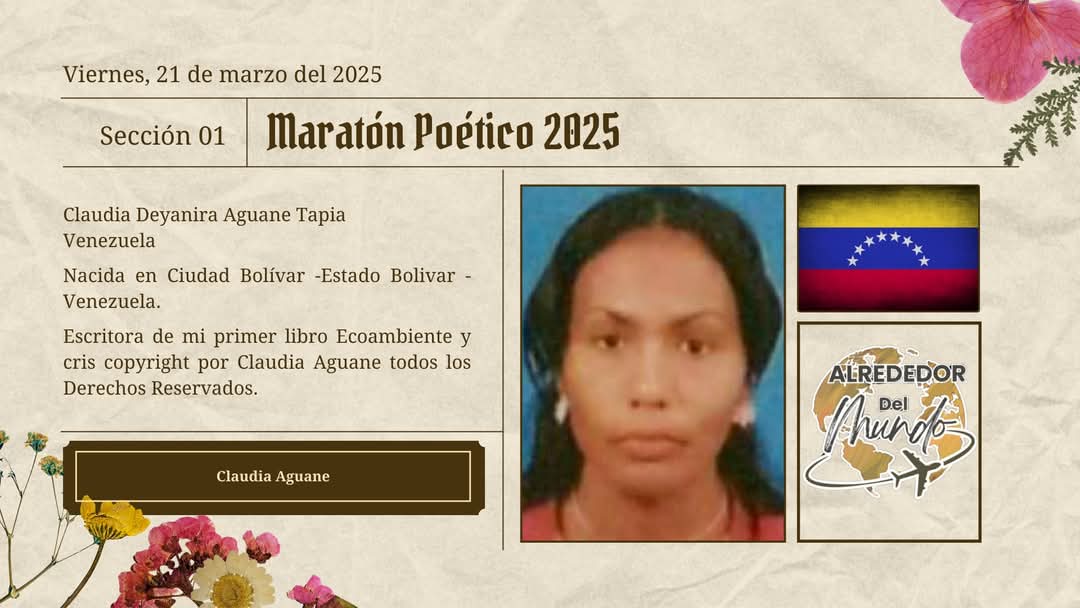
Claudia Deyanira Aguane Tapia – Venezuela presenta il suo libro

Foto cortesia di Claudia Deyanira Aguane Tapia – Venezuela


Claudia Deyanira Aguane Tapia
Venezuela

Nata a Ciudad Bolívar – Stato di Bolívar – Venezuela
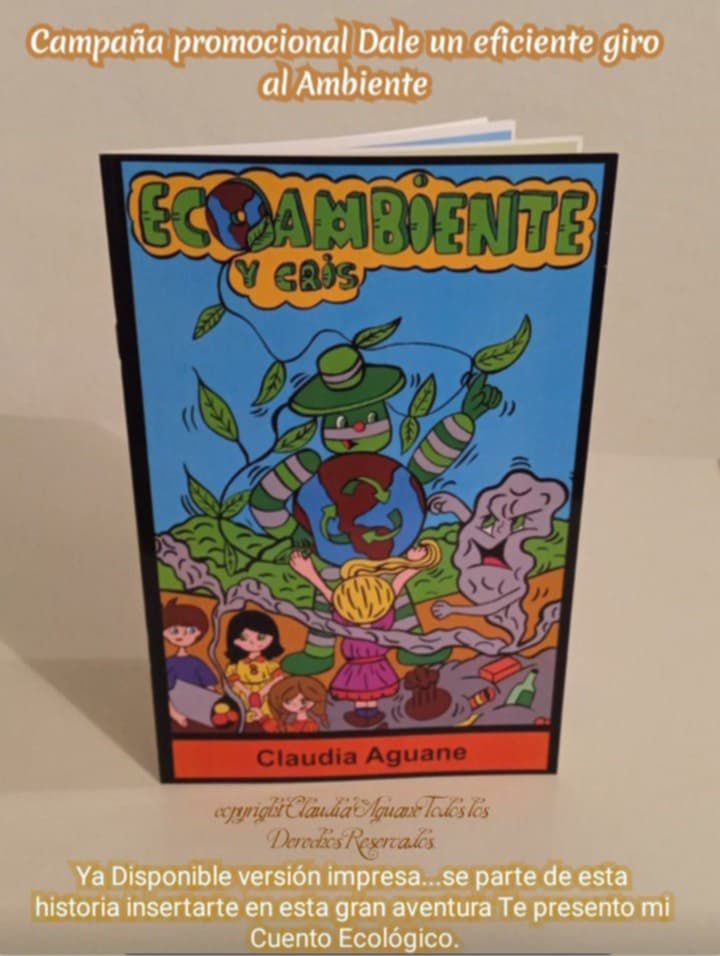
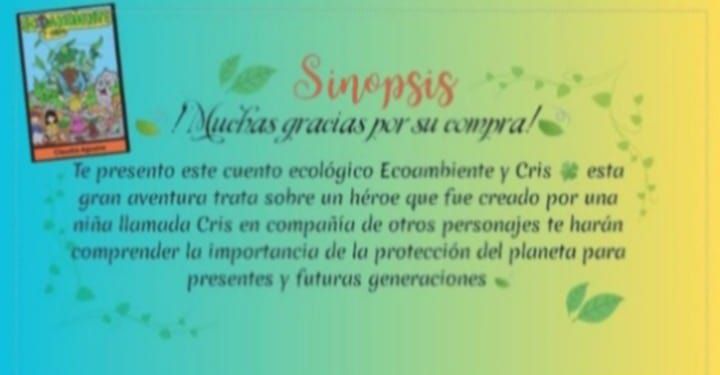
Autrice del mio primo libro, Ecoambiente y cris (Ecoambiente e cris), copyright di Claudia Aguane, tutti i diritti riservati. È una storia affascinante, ideale da godersi in famiglia e per tutti i pubblici. Promuove valori perduti, il recupero di un senso di appartenenza e la protezione del pianeta Terra per le generazioni presenti e future. Rafforza l’educazione ambientale. È un riferimento a una ragazza e ad altri personaggi e invita a seminare la consapevolezza ecologica.
Il mio slogan è “Diamo all’ambiente un tocco di efficienza”, testi, illustrazioni e interior design sono miei.
Oltre a ciò, ho sempre avuto una certa inclinazione per l’arte, faccio disegni, sono un’ artigiana, una creativa e una imprenditrice.
È un piacere partecipare alla Grande Maratona Poetica con la mia poesia “Credi in te”.


“I tempi di Dio sono perfetti… Se ti piacciono le avventure e sei appassionato di natura, questa storia è per te. Vi presento la mia storia ecologica Eco-ambiente e cris copyright di Claudia Aguane tutti i diritti riservati. È una storia affascinante, ideale da godersi in famiglia e con tutti i pubblici. Promuove valori che sono andati perduti, il salvataggio del senso di appartenenza, la protezione del pianeta Terra per le generazioni presenti e future… il mio slogan è Dai all’ambiente una svolta efficiente”. 

#daiefficienzaall’ambiente #credineltuopotenziale #educazioneambientale #follower @ecoambienteycris


Claudia Deyanira Aguane Tapia
Venezuela

Nacida en Ciudad Bolívar -Estado Bolivar – Venezuela
Escritora de mi primer libro Ecoambiente y cris copyright por Claudia Aguane todos los derechos reservados, es una historia fascinante, ideal para disfrutar en familia y toda audiencia, promueve valores que se han perdido el rescate del sentido de pertenencia, protección del planeta tierra para presentes y futuras generaciones, afianza la educación  ambiental, es referente a una niña y otros personajes, te invita a sembrar la conciencia ecológica.
Mi eslogan es “Dale un eficiente giro al Ambiente”, textos, ilustraciones , diseño interior de mi autoría.
Adicional a ello siempre he tenido inclinación por el arte, hago dibujos soy manualista, creativa y emprendedora.
Es grato tener está participación el Gran Maratón  Poético con mi poema “Creer en ti”.


Los Tiempos de Dios son perfectos…Si te gustan las aventuras y te apasiona la naturaleza este cuento es para ti te presento mi cuento Ecológico Ecoambiente y cris copyright por Claudia Aguane todos los Derechos Reservados es una historia fascinante ideal para disfrutar en familia y toda audiencia promueve valores que se han perdido rescate del sentido de pertenencia protección del planeta tierra para presentes y futuras generaciones….mi eslogan es Dale un eficiente giro al Ambiente. #daleuneficiemtegiroalambiente #creeentupotencial #educacionambiental #seguidores @ecoambienteycris

Leggi anche 👇

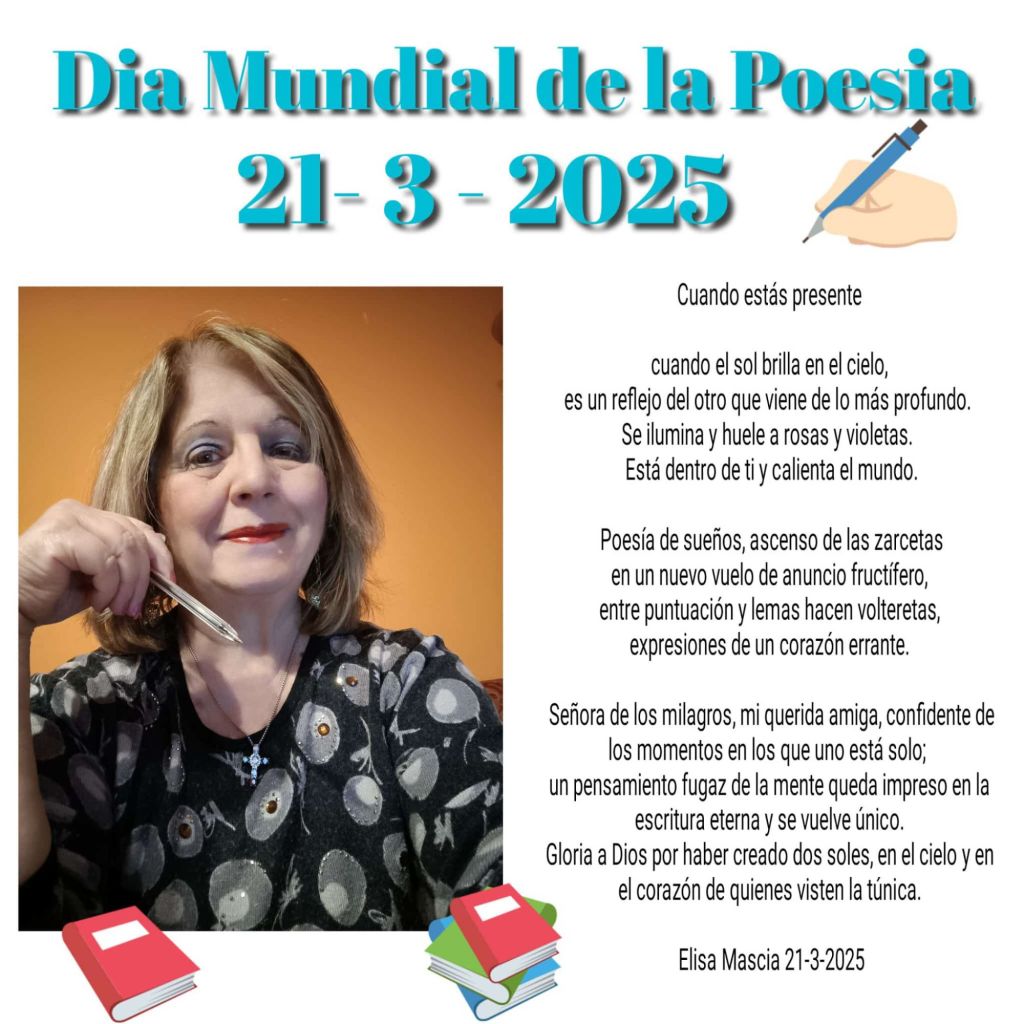
L’autrice Claudia Deyanira Aguane Tapia-Venezuela ha partecipato al Maraton Poetico Internazionale e presenta il suo libro, pubblicazione di Elisa Mascia -Italia

Per la giornata della  poesia

Foto di Elisa Mascia -Italia

Quando sei presente

Quando nel cielo splende il sole
è riflesso dell’ altro che dal profondo
illumina e profuma di rose e viole 
è dentro di te e scalda il mondo.

Poesia dei sogni, risalita delle marzaiole
in novello volo d’ annuncio fecondo
tra punteggiatura lemmi fan capriole
espressioni di cuore vagabondo.

Signora dei miracoli mia cara amica
confidente d’istanti in cui si è soli
pensiero fuggitivo dalla mente s’imprime

nell’ eterna scrittura diviene unica
gloria a Dio per aver creato due soli
in cielo e nel cuore di chi vestirà tunica.

Elisa Mascia 21-3-2025

Vedi anche 👇

https://vm.tiktok.com/ZMBk1mqGk/

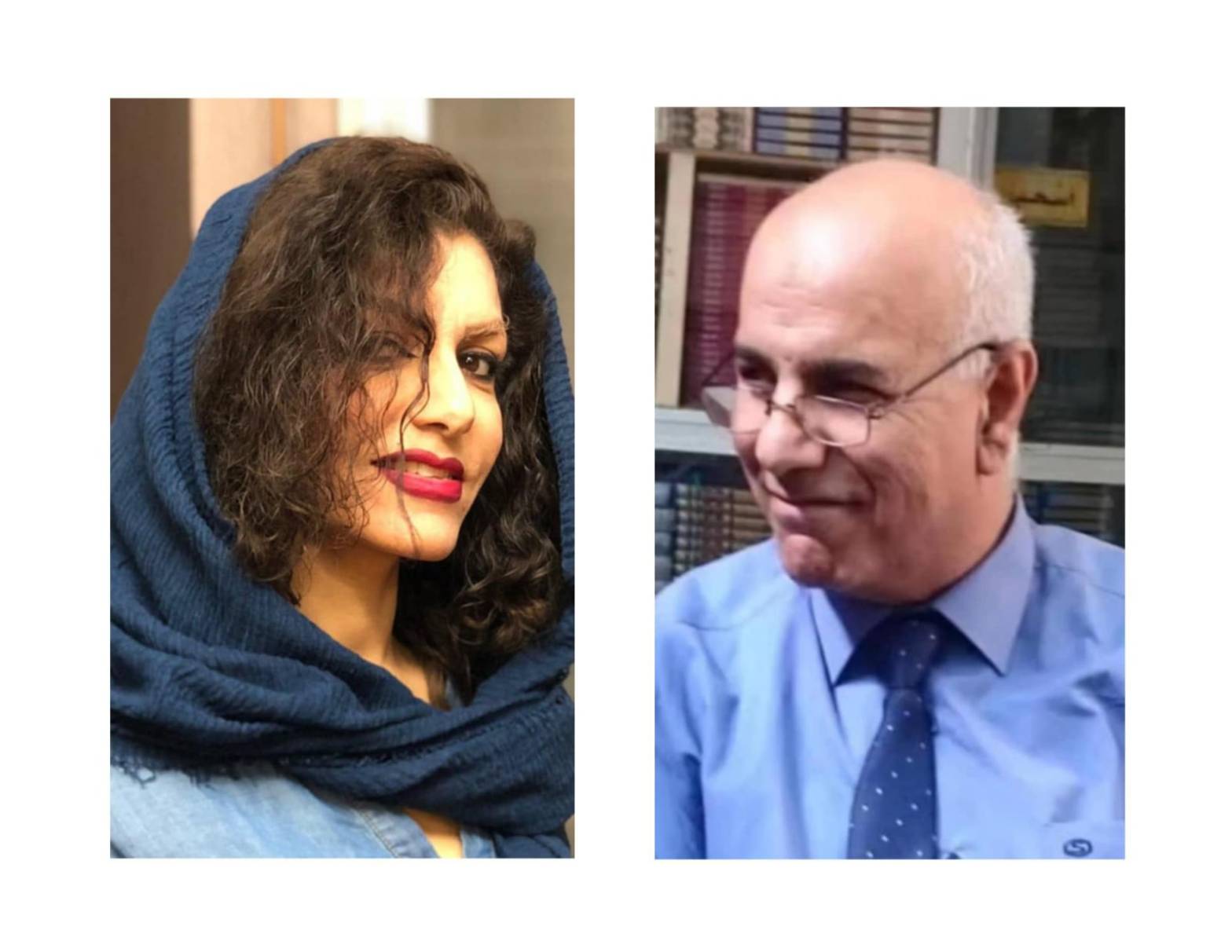
Elham Hamedi-Iran e la sua poesia nell’analisi critica letteraria del prof Kareem Abdullah -Iraq

Foto cortesia di Elham Hamedi-Iran e Kareem Abdullah -Iraq

Lettura stilistica analitica critica di “Rimuovere i cadaveri dalla mia faccia” da Elham Hamedi- Iran.
Di : Kareem Abdullah – Iraq .

Il poema di Elham Hamedi “Remove the Corpses from My Face” evoca un’atmosfera intensa e inquietante, mescolando immagini di vita, morte e rinnovamento. Attraverso il suo profondo linguaggio metaforico e l’uso innovativo della forma, il poema esamina la lotta per l’espressione personale e il peso delle pressioni sociali o esistenziali. In questa analisi critica, esploreremo le scelte stilistiche di Hamedi, gli elementi tematici e come lavorano insieme per creare un’esperienza complessa ed emotivamente risonante per il lettore.

1-Titolo e prime impressioni:
Il titolo, “Remove the Corpses from My Face,” introduce un paradosso immediato tra la vita e la morte, così come un profondo senso di perdita. La parola “cadaveri” non è solo letterale; evoca un’immagine di trauma passato, di repressione o dei resti di ciò che non è più vivo o autentico. La frase “dal mio volto” suggerisce che la persona è attivamente gravata da questi resti del passato, possibilmente aspettative esterne o dolore interiorizzato, che oscurano la loro vera identità. Questo evoca un senso di urgenza, come se la persona desiderasse liberarsi da questi pesi invisibili.

2- Immagini e simbolismo:
Il poema di Hamedi è ricco di linguaggio simbolico che contrappone la vita alla morte e la natura all’esistenza umana. Per esempio, la frase “I miei occhi respirano ancora” introduce un’immagine paradossale: gli occhi sono organi passivi, ma qui si attribuisce loro un’azione attiva e vivificante, la respirazione. Questo umanizza gli occhi, che sono spesso visti come recettori passivi del mondo che li circonda. Gli occhi che respirano suggeriscono che, nonostante il peso dei cadaveri, la persona ha ancora la capacità di interagire con il mondo.

L’immagine ricorrente dei “cadaveri” è centrale nella struttura tematica della poesia. L’immagine del cadavere nel poema suggerisce non solo la morte ma anche il decadimento, la stagnazione e forse i resti di vecchie versioni dell’io o precedenti imposizioni culturali, personali o politiche. Questa figura ricorrente implica anche che, anche se la persona può sembrare immobile o senza vita, rimane una vitalità di fondo-un tentativo di scartare ciò che non serve più.

Al contrario, le immagini naturali, come “I miei occhi possono ancora scalare il corpo di un albero” e “rivendicare un pezzo del cielo come loro attraverso le foglie”, introduce un senso di crescita, aspirazione e connessione con la natura. Queste linee implicano che, nonostante la presenza oppressiva dei “cadaveri”, il desiderio della persona per la libertà e la connessione con il mondo rimane ininterrotto. Arrampicarsi sul “corpo di un albero” metaforicamente si riferisce all’istinto umano di raggiungere l’alto, crescere e cercare significato. Il cielo, che simboleggia la possibilità illimitata, funge da metafora per l’io ideale, libero dal peso dei fardelli passati.

3- Struttura e ripetizione:
Uno dei più sorprendenti dispositivi stilistici in questo poema è la frase imperativa ripetuta “Rimuovere i cadaveri dalla mia faccia.” Questo ritornello ancora la poesia, fondandola in un desiderio coerente di liberazione. La ripetizione sottolinea l’urgenza e il peso emotivo della richiesta, come se la persona fosse in costante conflitto con il suo mondo esterno o interiore, cercando la liberazione. La richiesta di “rimuovere” non è semplicemente una richiesta, ma un disperato richiamo alla trasformazione, a uno spargimento del passato o delle forze oppressive che si sono accumulate nel tempo.

L’uso ripetuto di “My eyes” enfatizza la percezione visiva della persona, sottolineando l’idea che il loro sguardo e la prospettiva sono entrambi gravati e potenziati dalle loro esperienze. Gli occhi diventano il veicolo sia della sofferenza che del rilascio potenziale, in quanto sono capaci di “respirare” e “arrampicarsi sul corpo di un albero”, indicando sia una lotta presente che un potenziale di crescita.

4- Contrasto tra luce e buio:
Il contrasto tra luce e buio è significativo nel poema. Il sole e la luna sono giustapposti come fonti di illuminazione, ma rappresentano anche forze diverse. “Il sole moltiplica ancora il significato del giorno nei miei occhi” parla della vitalità e possibilità di vita, come il sole tradizionalmente simboleggia la luce, chiarezza e conoscenza. Tuttavia, questo è controbilanciato dall’immagine della luna, che “passa tra le mie sopracciglia / afferrando una parola / tra le mie labbra.” La passività della luna contrasta con la luminosità del sole, e la sua tranquilla “presa” di una parola può implicare che il significato sia imposto alla persona, piuttosto che scoperto liberamente. L’interazione tra il sole e la luna potrebbe essere interpretata come una rappresentazione del conflitto interno tra un desiderio di chiarezza e il peso schiacciante delle forze esterne.

5-Il tema del poema di soffocamento e rinascita:
Alla fine della poesia, Hamedi scrive: “Le parole sono soffocanti.” Questa frase introduce un senso improvviso di claustrofobia-le parole, solitamente gli strumenti della comunicazione e dell’autoespressione, qui diventano strumenti di oppressione. Riflette la tensione tra il desiderio di una voce autentica e l’imposizione schiacciante di vincoli sociali, culturali o personali che soffocano il sé.

Di fronte a parole soffocanti, gli occhi della persona rimangono “vivi” e ancora capaci di rivendicare “un pezzo di cielo”-suggerendo che nonostante sia soffocato, il potenziale di liberazione ed espressione non si perde mai del tutto.
L’immagine del soffocamento può essere simbolica della tensione tra la realtà attuale della persona e il suo desiderio di un’esistenza più autentica e libera.

6- Elementi stilistici e caratteristiche linguistiche:
L’uso di Hamedi di enjambment, in cui le frasi si estendono da una riga all’altra, crea un senso di fluidità e continuità. Questa tecnica rispecchia la natura implacabile e ciclica della lotta descritta nel poema: non c’è una chiara risoluzione, ma un continuo, urgente tentativo di liberarsi.

Il linguaggio semplice ma profondo esalta l’impatto emotivo della poesia. Attraverso linee brevi e dirette come “Rimuovi i cadaveri dal mio viso” e “Le parole sono soffocanti”, Hamedi cattura il dolore crudo e immediato della persona, usando un linguaggio sparso per trasmettere una profonda complessità emotiva. La sintassi è spesso frammentata, rispecchiando lo stato d’animo frammentato della persona, mentre la mancanza di punteggiatura aggiunge al senso di urgenza e disordine del poema.

Conclusione:
“Remove the Corpses from My Face” di Elham Hamedi è un poema profondamente evocativo e tematicamente ricco che esplora la tensione tra vita e morte, liberazione e oppressione, espressione di sé e costrizione sociale. Attraverso immagini naturali vivide, l’uso simbolico del sole e della luna e il ritornello ripetuto, Hamedi crea una narrazione toccante di lotta personale ed esistenziale. Il poema in definitiva suggerisce che anche di fronte al soffocamento e alla perdita, c’è ancora una scintilla di vitalità, e una possibilità di rinnovamento, per gli occhi che continuano a respirare e il cielo che rimane a portata di mano.


“Togli i cadaveri dalla mia faccia “

I miei occhi respirano ancora /
Rimuovi i cadaveri dal mio viso /
Il sole moltiplica ancora il significato del giorno nei miei occhi /
La luna passa tra le mie sopracciglia / Afferra una parola /
Tra le mie labbra /
E inizia una nuova interpretazione dell’umanità /
I miei occhi possono ancora scalare il tronco di un albero /
E reclamare un pezzo di cielo come loro attraverso le foglie /
Togli i cadaveri dalla mia faccia / Le parole sono soffocanti /

Elham Hamedi
Tutti i diritti riservati

Adattamento dal libro ; “UN COLPO ALLA TESTA ERA UNO ZAQBOOR”;Elham Hamedi; 2022; Terra d’ulivi Edizioni; Italia


Critical Analytical Stylistic Reading of “Remove the Corpses from My Face” by Elham Hamedi- Iran.
By : Kareem Abdullah – Iraq .

Elham Hamedi’s poem “Remove the Corpses from My Face” evokes an intense, haunting atmosphere, blending imagery of life, death, and renewal. Through its deep metaphorical language and innovative use of form, the poem examines the struggle for personal expression and the burden of societal or existential pressures. In this critical analysis, we will explore Hamedi’s stylistic choices, thematic elements, and how they work together to create a complex, emotionally resonant experience for the reader.

1-Title and First Impressions:
The title, “Remove the Corpses from My Face,” introduces an immediate paradox between life and death, as well as a profound sense of loss. The word “corpses” is not just literal; it evokes an image of past trauma, repression, or the remnants of what is no longer living or authentic. The phrase “from my face” suggests that the persona is actively burdened by these remnants of the past, possibly external expectations or internalized pain, which obscure their true identity. This evokes a sense of urgency, as if the persona longs for liberation from these invisible weights.

2- Imagery and Symbolism:
Hamedi’s poem is rich in symbolic language that contrasts life with death and nature with human existence. For instance, the line “My eyes are still breathing” introduces a paradoxical image—eyes are passive organs, but here they are ascribed an active, life-giving action, breathing. This humanizes the eyes, which are often seen as passive receivers of the world around them. The breathing eyes suggest that despite the weight of the corpses, the persona still holds the ability to engage with the world.

The recurring image of “corpses” is central to the thematic structure of the poem. Corpse imagery in the poem suggests not only death but also decay, stagnation, and perhaps the remnants of old versions of the self or previous cultural, personal, or political impositions. This recurring figure also implies that, even though the persona may seem still or lifeless, there remains an underlying vitality—an attempt to discard what no longer serves them.

In contrast, the natural imagery, such as “My eyes can still climb the body of a tree” and “claim a piece of the sky as their own through the leaves”, introduces a sense of growth, aspiration, and connection to nature. These lines imply that despite the oppressive presence of the “corpses,” the persona’s desire for freedom and connection to the world remains unbroken. Climbing the “body of a tree” metaphorically speaks to the human instinct to reach upward, to grow, and to seek meaning. The sky, symbolizing boundless possibility, serves as a metaphor for the ideal self, free from the weight of past burdens.

3- Structure and Repetition:
One of the most striking stylistic devices in this poem is the repeated imperative phrase “Remove the corpses from my face.” This refrain anchors the poem, grounding it in a consistent desire for liberation. The repetition emphasizes the urgency and emotional weight of the plea, as if the persona is in constant conflict with their external world or inner self, seeking release. The plea to “remove” is not merely a request but a desperate call for transformation, for a shedding of the past or oppressive forces that have accumulated over time.

The repeated use of “My eyes” emphasizes the visual perception of the persona, underlining the idea that their gaze and perspective are both burdened and empowered by their experiences. The eyes become the vehicle for both suffering and potential release, as they are capable of “breathing” and “climbing the body of a tree”—indicating both a present struggle and a potential for growth.

4- Contrast Between Light and Dark:
The contrast between light and dark is significant in the poem. The sun and moon are juxtaposed as sources of illumination but also represent different forces. “The sun still multiplies the meaning of day within my eyes” speaks to the vitality and possibility of life, as the sun traditionally symbolizes light, clarity, and knowledge. However, this is counterbalanced by the image of the moon, which “passes between my eyebrows / Seizing a word / Between my lips.” The moon’s passivity contrasts with the sun’s brightness, and its quiet “seizing” of a word may imply that meaning is being imposed upon the persona, rather than discovered freely. The interplay between the sun and the moon could be interpreted as a representation of the internal conflict between a desire for clarity and the overwhelming weight of external forces.

5-The Poem’s Theme of Suffocation and Rebirth:
At the conclusion of the poem, Hamedi writes: “The words are suffocating.” This phrase introduces a sudden sense of claustrophobia—words, usually the tools of communication and self-expression, here become instruments of oppression. It reflects the tension between the desire for authentic voice and the overwhelming imposition of societal, cultural, or personal constraints that suffocate the self.

In the face of suffocating words, the persona’s eyes remain “alive” and still capable of claiming “a piece of the sky”—suggesting that despite being stifled, the potential for liberation and expression is never fully lost. The imagery of suffocation may be symbolic of the tension between the persona’s current reality and their longing for a more authentic, free existence.

6- Stylistic Elements and Linguistic Features:
Hamedi’s use of enjambment, where sentences spill over from one line to the next, creates a sense of fluidity and continuity. This technique mirrors the relentless, cyclical nature of the struggle described in the poem—there is no clear resolution, but an ongoing, urgent attempt to break free.

The simple yet profound language enhances the emotional impact of the poem. Through short, direct lines such as “Remove the corpses from my face” and “The words are suffocating,” Hamedi captures the raw, immediate pain of the persona, using sparse language to convey deep emotional complexity. The syntax is often fragmented, mirroring the persona’s fragmented state of mind, while the lack of punctuation adds to the poem’s sense of urgency and disarray.

Conclusion:
“Remove the Corpses from My Face” by Elham Hamedi is a deeply evocative and thematically rich poem that explores the tension between life and death, liberation and oppression, self-expression and societal constraint. Through vivid natural imagery, symbolic use of the sun and moon, and the repeated refrain, Hamedi crafts a poignant narrative of personal and existential struggle. The poem ultimately suggests that even in the face of suffocation and loss, there is still a spark of vitality, and a possibility for renewal, for the eyes that continue to breathe and the sky that remains within reach.

“Remove the corpses from my face “
My eyes are still breathing /
Remove the corpses from my face /
The sun still multiplies the meaning of day within my eyes /
The moon passes between my eyebrows / Seizing a word /
Between my lips /
And begins a new interpretation of humanity /
My eyes can still climb the body of a tree /
And claim a piece of the sky as their own through the leaves /
Remove the corpses from my face / The words are suffocating /

Elham Hamedi
All Rights Reserved

Adapted from book ; “UN COLPO ALLA TESTA ERA UNO ZAQBOOR”;Elham Hamedi; 2022; Terra d’ulivi Edizioni; Italy

Leggi anche 👇

Elham Hamedi-Iran e la sua poesia ” Rimuovere i cadaveri dalla mia faccia” nell’analisi critica letteraria del prof Kareem Abdullah -Iraq, pubblicazione di Elisa Mascia -Italia

Nguyễn Thị Thùy Linh e una sua poesia

Foto cortesia di Nguyễn Thị Thùy LinhVietnam

ENTRA NEL MONDO

Non so se sono un uccello verde
con le ali spiegate incrostate di gioielli
O un’anguilla scivolosa che si erge con la coda?
Entro nel mondo confusa
Mancando appassionatamente la tua terra.

Ho trattenuto il respiro nell’immaginazione per ore
Per vivere e superare l’irrequietezza dei germogli che fioriscono
Rotto questo silenzio
Con l’altro silenzio
Più silenzioso e profondo
Fammi sapere,
sono della stessa lunghezza d’onda?
Come quando piango
Il fiume rimane senza fiato per alcuni secondi.
Rimpiangendo l’auto-omicidio di una goccia d’acqua sull’erba.

Sulla fredda spiaggia di sabbia
Le onde stanno divorando i primi frutti maturi
Come se i miei occhi avessero appena pianto
Quando tremando dirò che
Di fronte alla terra assolutamente pura
Toglierò questo corpo sacro
Solo per diventare un piccolo fiore
Cresce sulla retina del mondo
E il sangue dai petali dei fiori
si riversa per la salvezza.

NGUYỄN THỊ THÙY LINH (Vietnam)

Nguyễn Thị Thùy Linh, nata nel 1991, è una poetessa e traduttrice letteraria che ora vive a Hai Phong City, in Vietnam. Ha conseguito la laurea triennale in Economia presso l’Università nazionale di economia di Hanoi.
Ha ricevuto il premio “The Gold Moon of 6-8 poetry Prize”, il più alto riconoscimento conferito da The Elder Newspaper e dal sito web lucbat.com (co-organizzatore), sotto gli auspici del Comitato centrale del Fronte della patria vietnamita e del Buddisht Sangha del Vietnam. Inoltre, ha vinto il secondo premio in un concorso di poesia assegnato dalla rivista letteraria “Văn nghệ quân đội” per gli anni 2015-2016.
Ha tradotto e pubblicato due libri, un libro per bambini intitolato “The twin dolls to the earth” (Casa editrice della Vietnam Writer’s Association, 2016) scritto da Milutin Đuričković (Serbia) e una raccolta di poesie intitolata “Wings of the darkness” (Casa editrice della Vietnam Writer’s Association, 2018) composta da Raed Aljishi (Arabia Saudita).  Nguyễn Thị Thùy Linh ha tradotto dall’inglese al vietnamita (e pubblicato su molti giornali e riviste vietnamiti) numerose poesie internazionali scritte dal Dott. Gjekë Marinaj (Albania – America), Raymond Keen (America), Lars Vargö (Svezia), Rati Saxena (India), Metin Cengiz e Müesser Yeniay (Turchia), Fethi Sassi (Tunisia), Asror Allayarov e Makhfuza Imamova (Uzbekistan), Dimitris P. Kraniotis (Grecia) e Raed Aljishi (Arabia Saudita)…


ENTER THE WORLD

I do not know whether I am a green bird
with spread wings encrusted jewels
Or a slippery eel standing up with her tail?
Bewilderedly enter the world
Missing your earth passionately.

I held my breath in imagination for hours
To live and overcome the restless of sprouting buds
Broken this silence
By the other silence
Quieter and deeper
Let me know,
are they the same wavelength?
Like when I cry
The river remains breathless for a few seconds.
Regretting for self-murder of water drop on the grass.

On the cold sand beach
Waves are eating the ripening first fruits
Like my eyes have just cried
When trembling saying that
In front of the absolutely pure ground
I will take off this sacred body
Just to become a little flower
Grows on the world’s retina
And the blood from petal of flowers 
spill for salvation.


NGUYỄN THỊ THÙY LINH (Vietnam)

Nguyễn Thị Thùy Linh, born in 1991,  is a poetess  and literary translator who now lives in Hai Phong City, Vietnam. She received her Bachelor’s Degree in Economics from Hanoi National Economic University.
She was awarded “The Gold Moon of 6-8 poetry Prize,” the highest prize given by The Elder Newspaper and Website lucbat.com (co-organizer), under the auspices of Vietnamese Fatherland Front Central Committee and Buddisht Sangha of Vietnam. In addition, she won the Second Prize in a poetry contest awarded by “Văn nghệ quân đội” literary magazine for the years of 2015-2016. 
She has translated and published two books, a children’s book titled “The twin dolls to the earth” (Publishing House of The Vietnam Writer’s Association, 2016) written by Milutin Đuričković (Serbia) and a poetry collection called “Wings of the darkness” (Publishing House of The Vietnam Writer’s Association, 2018) composed by Raed Aljishi (Saudi Arabia).
Nguyễn Thị Thùy Linh has translated from English into Vietnamese (and published in many Vietnamese newspapers and magazines) numerous international poems authored by Dr. Gjekë Marinaj (Albania – America), Raymond Keen (America), Lars Vargö (Sweden), Rati Saxena (India), Metin Cengiz and Müesser Yeniay (Turkey), Fethi Sassi (Tunisia), Asror Allayarov and Makhfuza Imamova (Uzbekistan), Dimitris P. Kraniotis (Greece), and Raed Aljishi (Saudi Arabia)…

Leggi anche

Una poesia di Nguyá»…n Thị Thùy Linh – Vietnam, pubblicazione di Elisa Mascia -Italia

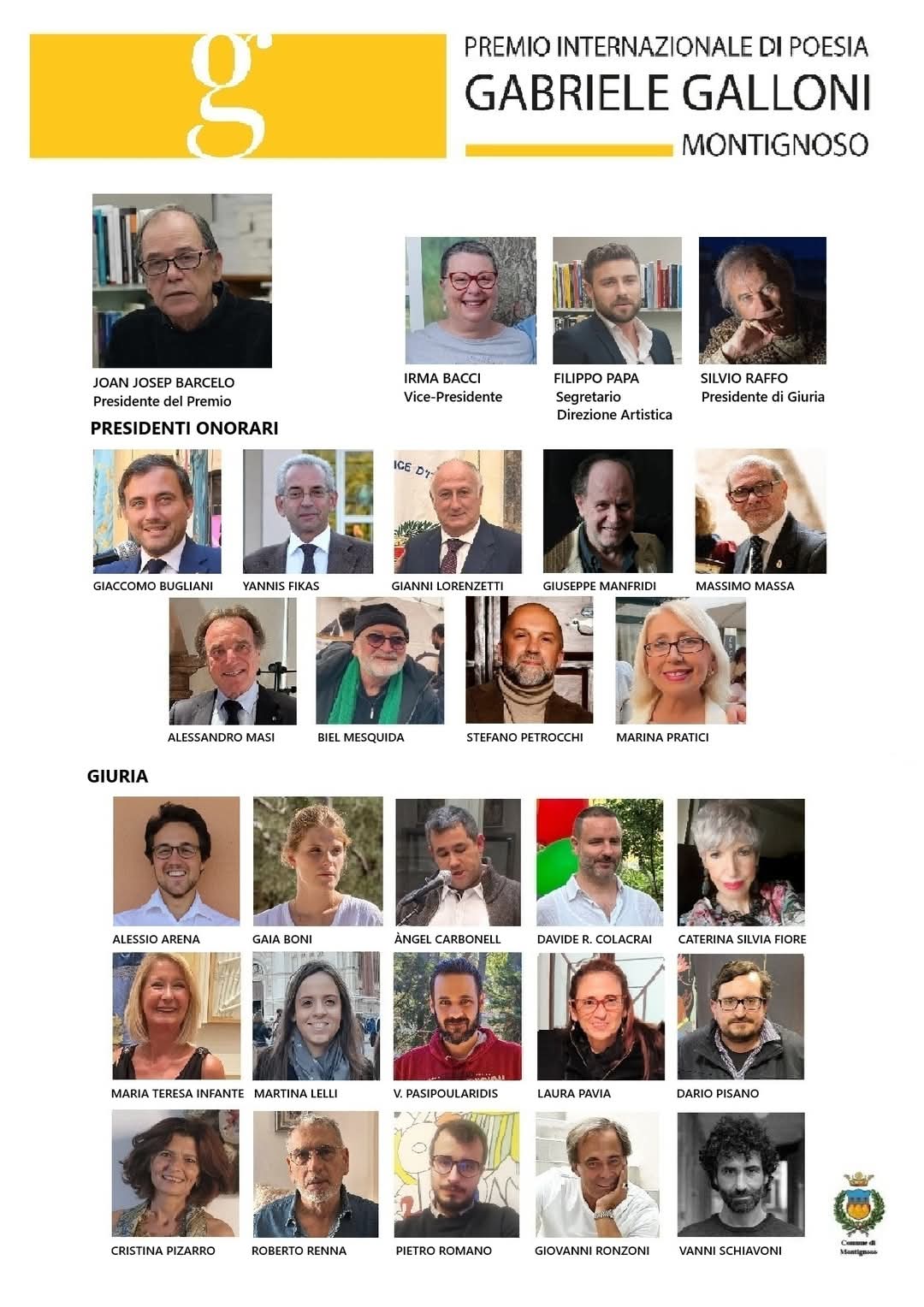
Concorso di poesie dedicato a Gabriele Galloni poeta e scrittore

Foto cortesia della locandina dell’evento culturale Gabriele Galloni

📢 PREMIO INTERNAZIONALE DI POESIA “GABRIELE GALLONI” – MONTIGNOSO – 1ª EDIZIONE 2025

Sono aperte le iscrizioni per la prima edizione del Premio Internazionale di Poesia “Gabriele Galloni”, che si terrà a Montignoso** nel 2025. Un’importante occasione per dare voce alla poesia e rendere omaggio a un grande talento letterario.

📅 Scadenza invio opere: 27 aprile 2025

🔗 Scarica il bando ufficiale: https://www.filippopapa.com/wp-content/uploads/2025/03/Premio-Internazionale-Galloni.pdf

Mohamed Rahal scrittore , ricercatore dall’Algeria invia un racconto della tradizione

Foto cortesia di Mohamed Rahal – Algeria


Mohamed Rahal / Scrittore, ricercatore algerino
Articolo: Prega per il Profeta

Questa è una poesia popolare tratta dal folklore sufi. Fu recitata nel XVII secolo e divenne ampiamente nota durante l’ascesa del Maddahat (arte performativa femminile) nell’Algeria occidentale, nelle province di Orano, Mostaganem, Ain Temouchent, Tiaret, Mascara, Sidi Ben Abbas e Tlemcen.

Informazioni sul folklore sufi

Il sufismo nel Nord Africa rappresenta un pilastro fondamentale della struttura psicologica dei musulmani in questo paese. È risaputo che la maggior parte dei santi e dei sufi risiedono in Algeria, in particolare nell’Algeria occidentale, che è considerata la regione con la più alta concentrazione di santi giusti nel Nord Africa. È considerata una tradizione profondamente radicata nel loro noto folklore ed è cantata in tutti i loro costumi e tradizioni, dai matrimoni e dalle celebrazioni popolari allo Zard e al Waad.

La lode del Profeta è una parte essenziale del sufismo.  È risaputo che la musica, in generale, rimane una compagna costante della lode del Profeta. La poesia popolare è stata la forma di poesia più nota fin dall’antichità. Scritta allo scopo di ricordare, la lode del Profeta veniva cantata ai matrimoni popolari sotto forma di sceicchi e interventi femminili. Si è evoluta nel tempo e in seguito è diventata nota nell’arte della musica rai algerina, che è diventata popolare negli anni ’70. A prima vista, può sembrare molto lontana da questa atmosfera religiosa, ma chiunque studi la storia di quest’arte scoprirà che si basa sull’uso del patrimonio popolare. È un movimento musicale e lirico emerso nell’Algeria occidentale alla fine degli anni ’60. Le sue origini risalgono agli sceicchi della canzone beduina e le sue antiche radici risalgono a quelli che in Algeria sono chiamati sceicchi. La lingua delle canzoni beduine deriva dal dialetto colloquiale, che è vicino all’arabo beduino. La maggior parte dei suoi temi sono lodi religiose e questioni sociali.  Durante il periodo coloniale francese, ha concentrato la sua attenzione sul racconto delle tragedie della popolazione, dalle difficoltà di vita ai mali sociali, attraverso i quali ha cercato di sensibilizzare i colonizzatori.

Testi di Sufi’s Praise

Queste canzoni utilizzano il dialetto algerino occidentale nei loro testi, con frasi semplici ma ricche di valori morali.  Ad esempio, questi testi cantati da Sheikha Safsajiya, che divenne famosa durante il periodo coloniale per impedire la politica di ignoranza praticata dai colonizzatori francesi contro il popolo algerino

“Padrone della Nazione, Muhammad, Salah Alaih Lebda” (Padrone della Nazione, Muhammad, prega sempre per lui)

“L’Haram, o Messaggero di Dio, l’Haram, o Amato di Dio, il giorno in cui sono venuto da te come un leone” (L’Haram, o Messaggero di Dio, la tua protezione, o Amato di Dio, vengo a piedi nudi chiedendoti protezione…)

“Preghiere per il Profeta di Dayan Street, Muhammad, o Dao della mia stanchezza, preghiere per il Profeta di Dayan Street, Muhammad, il Profeta, sulla punta della mia lingua.”  (Preghiere per il Profeta, il legislatore delle religioni, Muhammad il Profeta, la luce dei miei occhi. Preghiere per il Profeta, il legislatore delle religioni, Muhammad il Profeta, sempre sulla mia lingua.)

La sua popolarità come canzone

Quando il rai divenne popolare nei primi anni ’80, fu spesso accusato di essere una forma musicale che incita nei suoi testi, nonostante il fatto che molte poesie popolari fossero cantate da esso da poeti popolari dei secoli precedenti, come Abdelkader Batabji, Mustafa Ben Ibrahim, Abdelkader El Khalidi e Abdelkader Ya Boualem. Yamina, Bakhta e i canti di lode mondana nelle poesie “Prega per il Profeta” e “Prega con noi” furono cantati dalle prime generazioni.  Il primo artista a eseguirla, e in seguito gli sceicchi a cantarla, fu Cheb Khaled nel 1982. Fu poi ripubblicata da molti artisti e ridistribuita nel 1985 da Cheb Anwar, diventando una delle canzoni religiose più famose cantate nella storia della musica rai.

Quando la musica rai ottenne popolarità in tutto il mondo, questa canzone fu scelta per essere cantata al più grande concerto nella storia della rai, il Three Suns Festival, 1, 2, 3, il 18 settembre 1998.

Testo della poesia:

Prega per il Profeta **** I suoi compagni sono dieci

Mohamed El Manour ***** La pelle più bella

Lo dico ***** di fronte agli ascoltatori

Ai seguaci **** L’obbligatorio e il raccomandato

Sto mentendo **** Nella mia tomba, disteso
Ho sentito la polvere ***** cadere su di me

Sono deciso ***” Dio Onnipotente
Salva me stesso **** Per il fuoco rosso

Il meme del Messaggero **** Per la macchina Saadia
Visita la tomba della guida ***** Muhammad il Messaggero

Di’ alla macchina ***** Fatima al-Zahra
Costruiscimi un palazzo ***** di henné verde

Prega per il Profeta **** I suoi compagni sono dieci
Muhammad l’Illuminatore  ***** L’ornamento della pelle

Mohamed Rahal / Writer, Algerian Researcher
Article: Pray for the Prophet

This is a popular poem taken from Sufi folklore. It was recited in the 17th century and became widely known during the rise of the Maddahat (female performance art) in western Algeria, in the provinces of Oran, Mostaganem, Ain Temouchent, Tiaret, Mascara, Sidi Ben Abbas, and Tlemcen.

About Sufi Folklore

Sufism in North Africa represents a fundamental pillar of the psychological structure of Muslims in this country. It is well known that most of the saints and Sufis reside in Algeria, especially in western Algeria, which is considered the region with the highest concentration of righteous saints in North Africa. It is considered a deeply rooted tradition in their well-known folklore and is sung in all their customs and traditions, from weddings and popular celebrations to Zard and Waad.

Praise of the Prophet is an essential part of Sufism. It is well known that music, in general, remains a constant companion of praise of the Prophet. Popular poetry has been the most well-known form of poetry since ancient times. Written for the purpose of remembrance, the praise of the Prophet was sung at popular weddings in the form of sheikhs and female interventions. It evolved over time and later became known in the art of Algerian rai music, which became popular in the 1970s. At first glance, it may seem far removed from this religious atmosphere, but anyone studying the history of this art will find that it is based on the use of popular heritage. It is a musical and lyrical movement that emerged in western Algeria in the late 1960s. Its origins go back to the sheikhs of Bedouin song, and its ancient roots go back to what are called sheikhs in Algeria. The language of Bedouin songs is derived from the colloquial dialect, which is close to Bedouin Arabic. Most of its themes are religious praise and social issues. During the French colonial period, it focused its attention on recounting the tragedies of the population, from the difficulty of living and social ills, through which it sought to raise awareness among the colonizers.

Sufi’s Praise Lyrics

These songs use the western Algerian dialect in their lyrics, with simple phrases but rich in moral values. For example, these lyrics sung by Sheikha Safsajiya, who became famous during the colonial period to prevent the policy of The ignorance practiced by the French colonizers against the Algerian people

“Master of the Nation, Muhammad, Salah Alaih Lebda” (Master of the Nation, Muhammad, always pray for him)

“The Haram, O Messenger of God, the Haram, O Beloved of God, the day I came to you as a lion” (The Haram, O Messenger of God, your protection, O Beloved of God, I come barefoot asking you for protection…)

“Prayers for the Prophet of Dayan Street, Muhammad, O Dao of my tiredness, prayers for the Prophet of Dayan Street, Muhammad, the Prophet, on the tip of my tongue.” (Prayers for the Prophet, the legislator of religions, Muhammad the Prophet, the light of my eyes. Prayers for the Prophet, the legislator of religions, Muhammad the Prophet, always on my tongue.)

Its Popularity as a Song

When rai became popular in the early 1980s, it was often accused of being a musical form that incites in its lyrics, despite the fact that many popular poems were sung from it by popular poets from previous centuries, such as Abdelkader Batabji, Mustafa Ben Ibrahim, Abdelkader El Khalidi, and Abdelkader Ya Boualem. Yamina, Bakhta, and the songs of worldly praise in the poems “Pray for the Prophet” and “Pray with Us” were sung by early generations. The first artist to perform it, and later the sheikhs to sing it, was Cheb Khaled in 1982. It was then re-released by many artists, and redistributed in 1985 by Cheb Anwar, making it one of the most famous religious songs sung in the history of rai music.

When rai music gained worldwide popularity, this song was chosen to be sung at the greatest concert in the history of rai, the Three Suns Festival, 1, 2, 3, on September 18, 1998.

Lyrics of the poem:

Pray for the Prophet **** His companions are ten

Mohamed El Manour ***** The most beautiful skin

I say it ***** in front of the listeners

To the followers **** The obligatory and the recommended

I am lying **** In my grave, stretched out
I felt the dust ***** falling on me

I am decisive ***” God Almighty
Save myself **** For the red fire

The Messenger’s meme **** For the Saadia machine
Visit the grave of the guide ***** Muhammad the Messenger

Tell the machine ***** Fatima al-Zahra
Build me a palace ***** of green henna

Pray for the Prophet **** His companions are ten
Muhammad the enlightener ***** The adornment of the skin

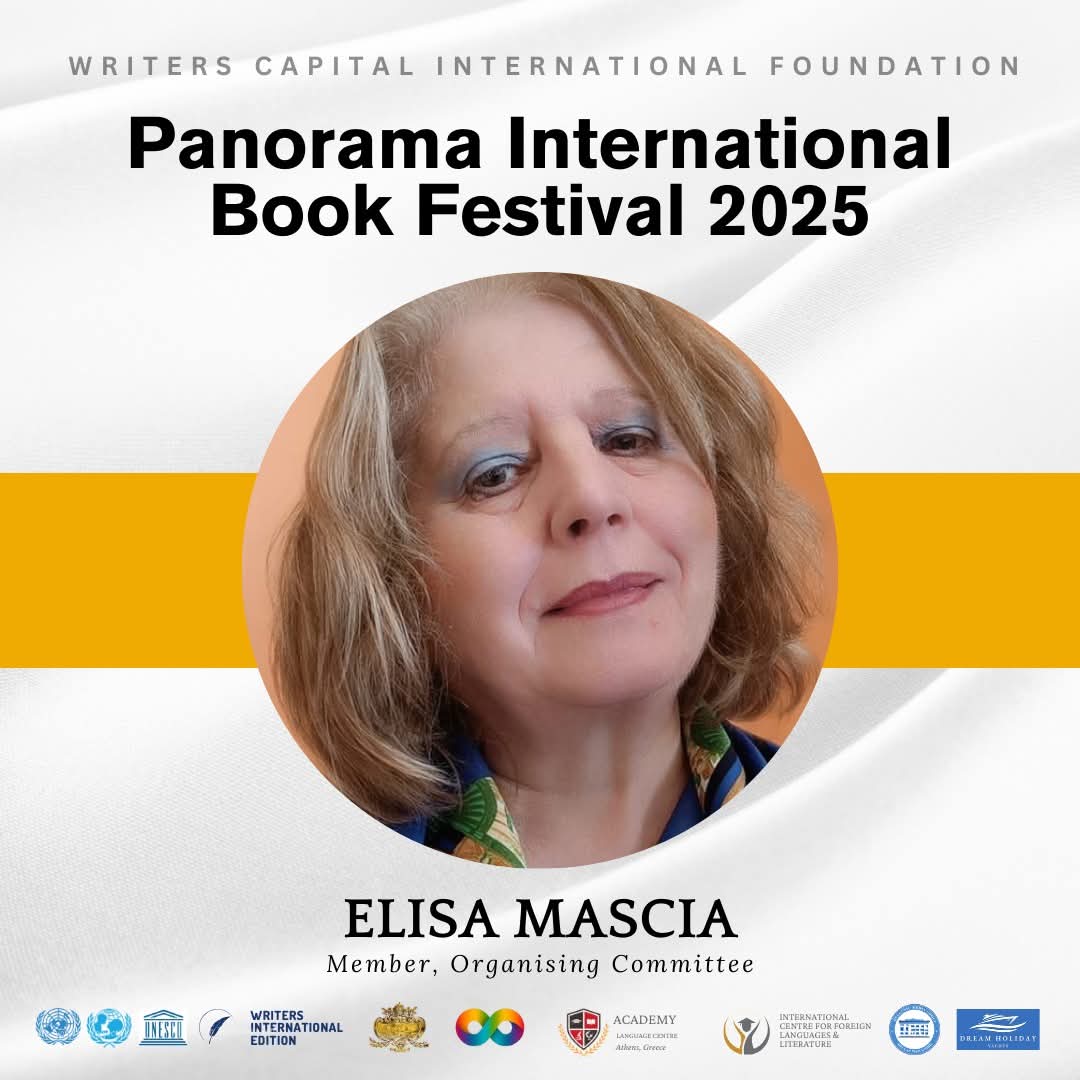
Panorama Internazionale Book Festival 2025

Foto cortesia della locandina dell’evento culturale Golden Book Awards

PANORAMA INTERNATIONAL BOOK FESTIVAL 2025: BENVENUTA ELISA MASCIA, MEMBRO DEL COMITATO ORGANIZZATIVO

Siamo lieti di dare il benvenuto a Elisa Mascia nel Comitato Organizzativo del Panorama International Book Festival 2025, il grande festival del libro che riunisce autori da tutto il mondo.

Nata nel 1956 a Santa Croce di Magliano, in Italia, Elisa Mascia è una poetessa, scrittrice e ambasciatrice culturale di San Giuliano di Puglia. Madre di quattro figli e nonna di due, è autrice di La Grattugia della Luna (2019) e traduttrice di Savage Wind. Con una serie di premi di poesia, è membro fondatore di WikiPoesia, voce di Radio Krysol Internazionale e coordinatrice italiana per la Writers Capital Foundation. Nel 2021 ha ricevuto la Bandiera Universale della Pace dal Movimento Pacis Nuntii argentino.

PORTA IL TUO LIBRO SU UN PALCOSCENICO GLOBALE E DIVENTA UN AUTORE PREMIATO!

La Writers Capital International Foundation ti invita a partecipare al Panorama International Book Festival 2025, uno dei festival del libro più lunghi al mondo, celebrato in tutto il mondo. Questa è un’incredibile opportunità per:

• Presentare il tuo libro con tecnologie all’avanguardia
• Condividere la tua storia tramite YouTube e social media
• Ottenere un’ampia gamma di copertura mediatica e migliorare la SEO
• Competi per i Panorama Golden Book Awards
• Presentati nel Quill Compendium 2025

🔗 Registrati ora:

Festival: https://rzp.io/rzp/PIBF2025
Premi: https://rzp.io/rzp/PGBGlobal

🌍 Fatti celebrare. Fatti ricordare. Fatti conoscere a livello globale.

Seguiteci su Writers Capital International Foundation:

🌐 http://www.writerscapital.org
✉️ wcifcentral@gmail.com

#PanoramaBookFestival #GlobalAuthors #GoldenBookAwards #ElisaMascia #LiteraryLegacy

PANORAMA INTERNATIONAL BOOK FESTIVAL 2025: WELCOME ELISA MASCIA, MEMBER, ORGANISING COMMITTEE

We’re delighted to welcome Elisa Mascia to the Organizing Committee of the Panorama International Book Festival 2025, the grand festival of books gathering authors from around the globe.

Born in 1956 in Santa Croce di Magliano, Italy, Elisa Mascia is a poet, writer, and cultural ambassador from San Giuliano di Puglia. A mother of four and grandmother of two, she’s the author of La Grattugia della Luna (2019) and translator of Savage Wind. With a string of poetry awards, she’s a founding member of WikiPoesia, a voice on Radio Krysol Internazionale, and Italy Coordinator for the Writers Capital Foundation. In 2021, she received the Universal Flag of Peace from Argentina’s Pacis Nuntii Movement.

TAKE YOUR BOOK TO A GLOBAL STAGE AND BECOME AN AWARD-WINNING AUTHOR!

Writers Capital International Foundation invites you to participate in Panorama International Book Festival 2025, one of the world’s lengthiest book festivals, celebrated across the globe. This is an incredible opportunity to:

• Showcase your book with cutting-edge tech
• Share your story via YouTube and social media
• Get wide range of media coverage and improve SEO
• Compete for the Panorama Golden Book Awards
• Feature yourself in Quill Compendium 2025

🔗 Register Now:

Festival: https://rzp.io/rzp/PIBF2025
Awards: https://rzp.io/rzp/PGBGlobal

🌍 Be celebrated. Be remembered. Be global.

Follow us at Writers Capital International Foundation:

🌐 http://www.writerscapital.org
✉️ wcifcentral@gmail.com

#PanoramaBookFestival #GlobalAuthors #GoldenBookAwards #ElisaMascia #LiteraryLegacy

Al Panorama Internazionale Letteratura con il Golden Book Awards 2025

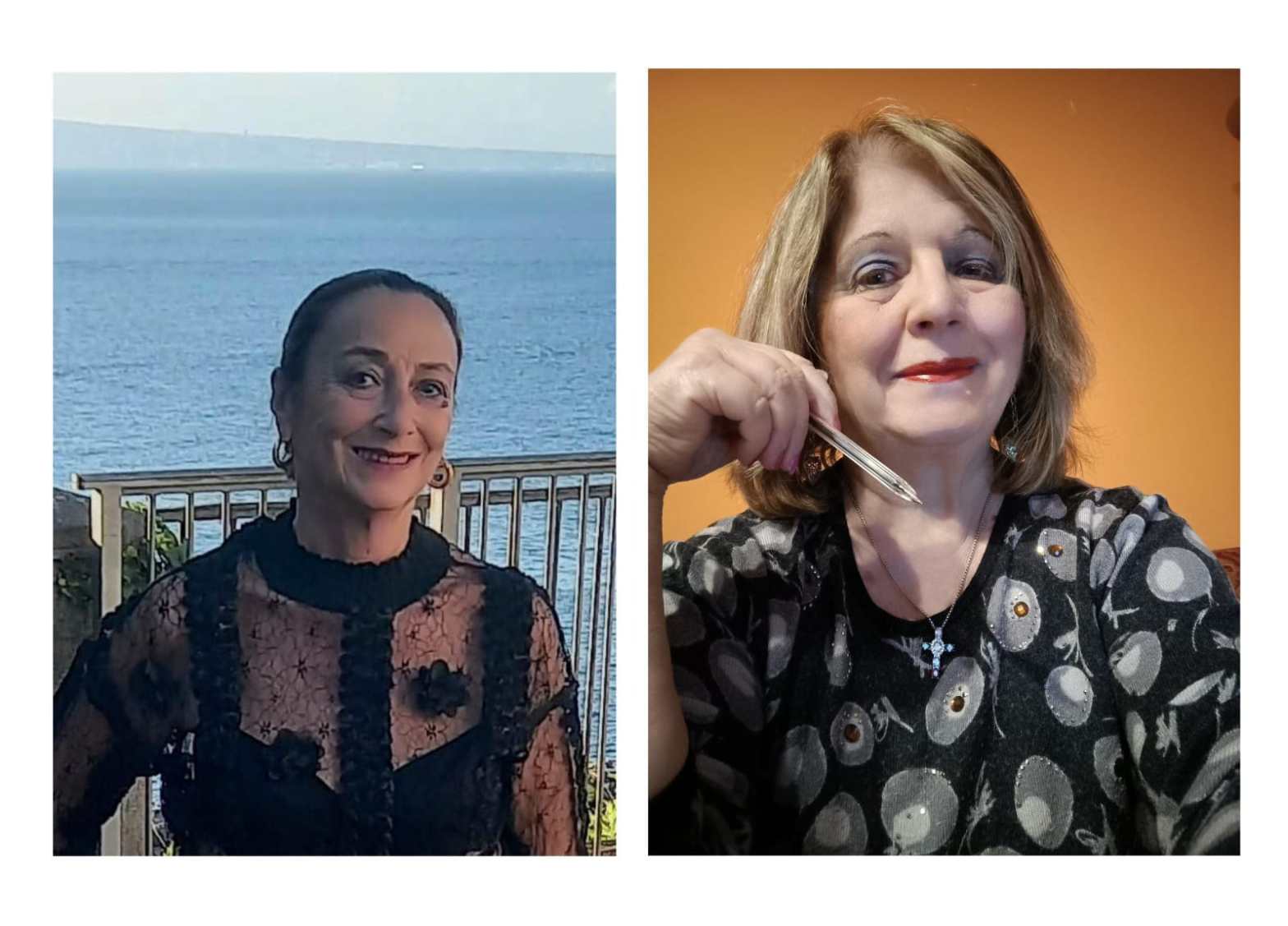
Letizia Caiazzo,artista, scrittrice, video maker ha creato il video della poesia di Elisa Mascia -Italia

Foto cortesia di Letizia Caiazzo ed Elisa Mascia

“Ritratto di una donna”


Nasce un dipinto


Quando donna nel silenzio in riflessione
sola, mente e anima iniziano a dialogare
in ascolto per piacevole connessione
raccontano i segreti del saper amare.

In cuore ha racchiuso grande emozione
con sapienza e solo lei sa donare
è dell’universo in magica effusione
naturale è il suo fantastico cambiare.

Catartica si trasforma come farfalla
è multicolore affascinante incanta
quadro magico in cornice preziosa

spesso più affonda e più viene a galla
lei che col suo dire di luce ammanta,
bambina, mamma, nonna o dolce sposa.

Elisa Mascia 7-3-2025

Il critico letterario Kareem Abdullah -Iraq scrive l’analisi dettagliata alla poesia: ” L’abbraccio dell’ alba, la grazia del giorno” di Frieda Norma Dela Cruz – Filippine

Foto cortesia di Frieda Norma Dela Cruz – Filippine e Kareem Abdullah -Iraq


Lettura analitica e critica di “L’abbraccio dell’alba, la grazia del giorno” della dott.ssa Frieda Norma Dela Cruz – Filippine .
Di: kareem Abdullah – Iraq .

In “L’abbraccio dell’alba, la grazia del giorno”, la Dr.ssa Frieda Norma Dela Cruz tesse un bellissimo arazzo di consapevolezza, pace interiore e il ritmo costante di una vita equilibrata. Attraverso le immagini del viaggio della giornata, dall’alba al sonno, la poesia presenta un approccio olistico alla vita, che enfatizza consapevolezza, gratitudine e senso di motivazione in ogni parte della giornata.

Analisi tematica:
Il tema centrale della poesia ruota attorno all’idea di consapevolezza e risveglio spirituale. La poetessa usa la natura ciclica del giorno per rispecchiare le fasi della crescita personale e della pace interiore. Dal “dolce richiamo” del sole nascente al sonno tranquillo di notte, ogni sezione della giornata è un’opportunità per la riflessione, la connessione e l’equilibrio.

Mattina: la poesia inizia con l’alba, che simboleggia il risveglio dell’anima e l’inizio di un nuovo giorno. Le parole “una preghiera sussurrata, un inizio grato” riflettono un atteggiamento di gratitudine e riverenza. Suggerisce che anche i più piccoli momenti di quiete e preghiera possono dare il tono per una giornata tranquilla e intenzionale.

Mezzogiorno: Mentre il giorno progredisce, c’è una transizione dal risveglio spirituale all’impegno fisico. L’immagine del corpo che si muove “con forza e facilità” in “una danza vibrante sulla brezza” suggerisce un equilibrio fluido tra il benessere mentale e fisico. Il poeta sottolinea l’importanza di rimanere presente e impegnata, simboleggiato attraverso “lavoro profondo” e una “mente concentrata.”

Sera: il poema si sposta verso la riflessione. La serata è segnata da un senso di contemplazione tranquilla, con frasi come “pace di riflessione” e “i miei pensieri raccolti, nel profondo.” Qui, la poetessa sottolinea l’importanza di fare una pausa, raccogliere i propri pensieri e impegnarsi in pratiche riflessive come tenere un diario e meditazione per coltivare la pace interiore.

Notte: Alla fine della giornata, il poema si muove verso le fasi finali di riposo e ringiovanimento. “Il sonno scende, una dolce liberazione” simboleggia l’importanza di arrendersi per riposare, permettendo alla mente e al corpo di ricaricarsi. La fine tranquilla della giornata è descritta come “pace interiore”, fornendo un senso di chiusura e rinnovamento.

Analisi strutturale e stilistica:
La struttura del poema rispecchia la progressione di un singolo giorno, che esalta il suo focus tematico sulla mindfulness e sul ritmo della vita. Ogni stanza segue il passare del tempo, e le transizioni senza soluzione di continuità da una parte della giornata all’altra riflettono il flusso continuo di pace interiore e motivazione nella vita della poetessa.

Immagini e simbolismo: Il poema è ricco di immagini che collegano il mondo esterno (il sole, la brezza, la campana) al mondo interno dell’oratore. L’uso di “il sole sorge”, “danza vibrante”, “lavoro profondo” e “pagine girano” servono come metafore per la crescita personale, stimolazione intellettuale, e la ricerca attiva della conoscenza. Queste immagini non solo evocano un senso di serenità, ma sottolineano anche un impegno attivo con la vita.

Tono e stato d’animo: il tono della poesia è calmo, contemplativo ed edificante. L’uso da parte della poetessa di un linguaggio semplice ma potente coltiva uno stato d’animo pacifico, guidando il lettore attraverso la giornata con facilità. Parole come “grato,” “ritmo pacifico,” “sonno tranquillo,” e “equilibrio” contribuiscono a un senso generale di serenità, che incoraggia la consapevolezza nel lettore.

Ripetizione: La ripetizione di frasi chiave come “un inizio grato”, “una mente concentrata” e “pace interiore” rinforza l’idea della consapevolezza coerente e dell’equilibrio. Questa ripetizione rispecchia anche la natura ciclica della giornata e il processo in corso di autoriflessione e sviluppo personale.

Dimensioni filosofiche e spirituali:
Il poema della Dr.ssa Dela Cruz invoca una filosofia spirituale di vivere in armonia con il mondo interno ed esterno. L’enfasi sulla mindfulness-essere pienamente presenti nel momento, sia nella preghiera, nel lavoro o nel riposo-si allinea con molte tradizioni spirituali e filosofiche che sottolineano l’importanza di essere in sintonia con il proprio io interiore.

Consapevolezza e presenza: la scelta della poetessa di concentrarsi su ogni parte della giornata, dalla quiete del mattino alla tranquillità del sonno, è una meditazione sul significato della mindfulness nella vita quotidiana. Piuttosto che correre nel tempo, la poetessa sostiene la vita intenzionale, una pratica di essere pienamente presenti e sintonizzati con l’ambiente circostante, le emozioni e i pensieri.

Equilibrio e armonia: il poema suggerisce che la vera soddisfazione e felicità vengono dal raggiungimento dell’equilibrio tra il fisico e lo spirituale, lavoro e riposo, pensiero e azione. Questo approccio equilibrato si riflette nelle immagini di “una vita equilibrata” e “spirito sano, fiamma ardente”, che simboleggia il fuoco dello scopo e della vitalità che alimenta la propria esistenza quotidiana.

Conclusione:
“Abbraccio dell’alba, grazia del giorno” è una poesia elegante e introspettiva che riflette la bellezza di vivere con consapevolezza, intenzione ed equilibrio. Dr.ssa Frieda Norma Dela Cruz presenta una visione olistica della vita che integra la mente, il corpo e lo spirito, dove ogni momento, sia attivo o riflessivo, serve uno scopo superiore. Attraverso immagini vivide e un tono riflessivo, la poesia guida il lettore attraverso le tappe di una giornata, dimostrando come ogni momento sia un’opportunità di crescita, pace e connessione con se stessi e con il mondo. Il poema incoraggia a vivere consapevolmente, trovando la bellezza in ogni momento e abbracciando l’intero spettro dell’esperienza umana.

L’abbraccio dell’alba, la grazia del giorno

Il sole sorge, una dolce chiamata,
La mia anima si risveglia, eretta e alta.
Una preghiera sussurrata, un inizio grato,
un ritmo pacifico nel cuore.

Poi il corpo si muove con forza e facilità,
una danza vibrante sulla brezza.
Il lavoro profondo si svolge, la mente è concentrata,
in ogni azione scopro una motivazione.

La campana del mezzogiorno suona, un attimo di pausa,
per la preghiera grata, senza causa,
una camminata consapevole sotto il sole,
nuove conoscenze cercate fino al tramonto.

Le pagine girano, le idee si accendono,
la ricerca si svolge in una luce sempre più sbiadita.
Come la sera scende, passo dolcemente per riposare e calmare la mia mente.

La pace della riflessione mi guida con gentilezza, i miei pensieri sono raccolti nel profondo.
Tra le righe del diario scorre il mio spirito e la calma della meditazione.

Poi il sonno scende, una dolce liberazione,
un sonno tranquillo, pace interiore.
Risvegliarsi riposata, con nuova forza,
per una vita equilibrata, per sempre vera.

Questo sentiero consapevole scelgo di percorrere,
per rivendicare uno spirito sano, una fiamma ardente.
Inarrestabile, nel cuore e nell’anima,
Il vero equilibrio della mia vita,
che mi rende completa.

Dr. Frieda Norma Dela Cruz
Filippine 
14 marzo 2025


Analytical and Critical Reading of “Dawn’s Embrace, Day’s Grace” by Dr. Frieda Norma Dela Cruz – Philippines .
By : kareem Abdullah – Iraq .

In “Dawn’s Embrace, Day’s Grace,” Dr. Frieda Norma Dela Cruz weaves a beautiful tapestry of mindfulness, inner peace, and the steady rhythm of a balanced life. Through the imagery of the day’s journey—from dawn to sleep—the poem presents a holistic approach to living, one that emphasizes awareness, gratitude, and a sense of purpose throughout every part of the day.

Thematic Analysis:
The central theme of the poem revolves around the idea of mindfulness and spiritual awakening. The poet uses the cyclical nature of the day to mirror the cycle of personal growth and inner peace. From the “gentle call” of the rising sun to the tranquil slumber at night, each section of the day is an opportunity for reflection, connection, and balance.

Morning: The poem begins with the sun’s rise, symbolizing the awakening of the soul and the start of a new day. The words “a whispered prayer, a grateful start” reflect an attitude of gratitude and reverence. It suggests that even the smallest moments of stillness and prayer can set the tone for a peaceful and purposeful day.

Midday: As the day progresses, there is a transition from spiritual awakening to physical engagement. The imagery of the body moving “with strength and ease” in “a vibrant dance upon the breeze” suggests a fluid balance between mental and physical well-being. The poet emphasizes the importance of staying present and engaged, symbolized through “deep work” and a “focused mind.”

Evening: The poem shifts towards reflection. The evening is marked by a sense of quiet contemplation, with phrases like “reflection’s peace” and “my thoughts collected, deep inside.” Here, the poet emphasizes the importance of pausing, gathering one’s thoughts, and engaging in reflective practices such as journaling and meditation to cultivate inner peace.

Night: As the day ends, the poem moves toward the final stages of rest and rejuvenation. “Sleep descends, a sweet release” symbolizes the importance of surrendering to rest, allowing the mind and body to recharge. The quiet end to the day is described as “inner peace,” providing a sense of closure and renewal.

Structural and Stylistic Analysis:
The poem’s structure mirrors the progression of a single day, which enhances its thematic focus on mindfulness and the rhythm of life. Each stanza follows the passage of time, and the seamless transitions from one part of the day to the next reflect the continuous flow of inner peace and purpose in the poet’s life.

Imagery and Symbolism: The poem is rich with imagery that connects the external world (the sun, the breeze, the bell) to the internal world of the speaker. The use of “the sun ascends,” “vibrant dance,” “deep work,” and “pages turn” serves as metaphors for personal growth, intellectual stimulation, and the active pursuit of knowledge. These images not only evoke a sense of serenity but also emphasize an active engagement with life.

Tone and Mood: The tone of the poem is calm, contemplative, and uplifting. The poet’s use of simple but powerful language cultivates a peaceful mood, guiding the reader through the day with ease. Words like “grateful,” “peaceful rhythm,” “tranquil slumber,” and “balance” contribute to an overall sense of serenity, which encourages mindfulness in the reader.

Repetition: The repetition of key phrases such as “a grateful start,” “a focused mind,” and “inner peace” reinforces the idea of consistent mindfulness and balance. This repetition also mirrors the cyclical nature of the day and the ongoing process of self-reflection and personal development.

Philosophical and Spiritual Dimensions:
Dr. Dela Cruz’s poem invokes a spiritual philosophy of living in harmony with both the internal and external world. The emphasis on mindfulness—being fully present in the moment, whether in prayer, work, or rest—aligns with many spiritual and philosophical traditions that emphasize the importance of being in tune with one’s inner self.

Mindfulness and Presence: The poet’s choice to focus on every part of the day, from the quiet of the morning to the peacefulness of sleep, is a meditation on the significance of mindfulness in daily life. Rather than rushing through time, the poet advocates for intentional living, a practice of being fully present and attuned to one’s surroundings, emotions, and thoughts.

Balance and Harmony: The poem suggests that true fulfillment and happiness come from achieving balance between the physical and the spiritual, work and rest, thought and action. This balanced approach is reflected in the imagery of “a balanced life” and “healthy spirit, burning flame,” which symbolically represents the fire of purpose and vitality that fuels one’s daily existence.

Conclusion:
“Dawn’s Embrace, Day’s Grace” is an elegant and introspective poem that reflects the beauty of living with mindfulness, intention, and balance. Dr. Frieda Norma Dela Cruz presents a holistic vision of life that integrates the mind, body, and spirit, where each moment, whether active or reflective, serves a higher purpose. Through vivid imagery and reflective tone, the poem guides the reader through the stages of a day, demonstrating how each moment is an opportunity for growth, peace, and connection to both oneself and the world. The poem encourages living consciously, finding beauty in each moment, and embracing the full spectrum of the human experience.

Dawn’s Embrace, Day’s Grace

The sun ascends, a gentle call,
My soul awakens, standing tall.
A whispered prayer, a grateful start,
A peaceful rhythm in my heart.

Then body moves, with strength and ease,
A vibrant dance upon the breeze.
Deep work unfolds, a focused mind,
In every action, purpose I find.

The noon bell chimes, a moment’s pause,
For thankful prayer, without a cause,
A mindful walk, beneath the sun,
New knowledge sought, till day is done.

The pages turn, ideas ignite,
Research unfolds, in fading light.
As evening falls, I softly tread,
To rest and calm, within my head.

Reflection’s peace, a gentle guide,
My thoughts collected, deep inside.
In journal’s lines, my spirit flows,
And meditation’s quiet glow.

Then sleep descends, a sweet release,
A tranquil slumber, inner peace.
Awake refreshed, with strength anew,
A balanced life, forever true.

This mindful path, I choose to claim,
A healthy spirit, burning flame.
Unstoppable, in heart and soul,
My life’s true balance, making me whole.

Dr. Frieda Norma Dela Cruz
Philippines 
March 14, 2025

Progetta un sito come questo con WordPress.com
Comincia ora