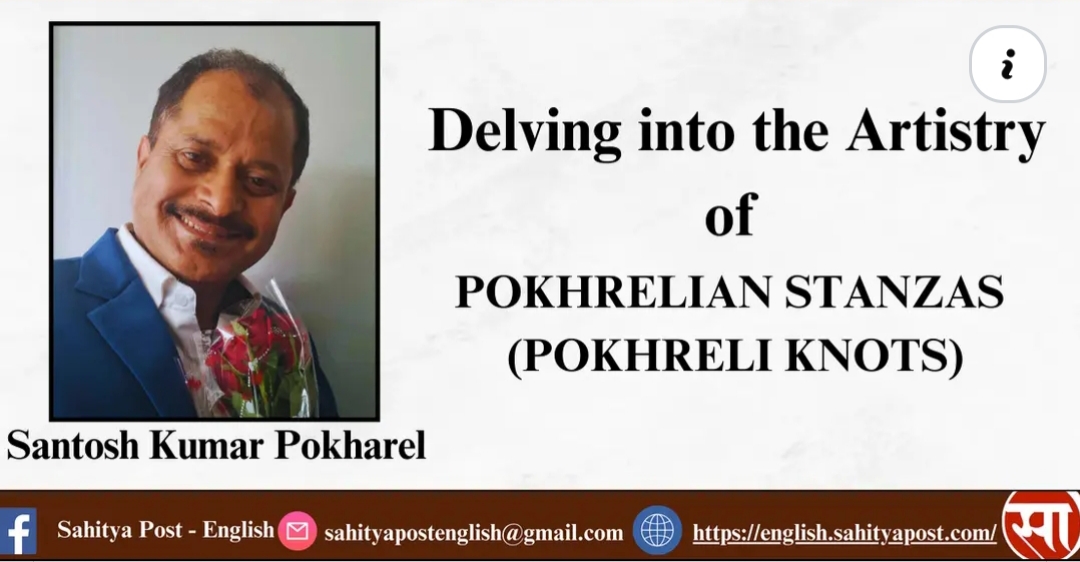
Foto cortesia con Santosh Kumar Pokharel
Immergersi nell’arte di POKHRELIAN STANZAS (POKHRELI NODI)
I poeti di tutto il mondo stanno sperimentando con POKHRELIAN STANZAS (POKHRELI NODI)!
Mi dà immenso piacere vedere i miei nodi Pokhreli riconosciuti a livello globale e essere utilizzati dai poeti nella creazione di poesie. Molto recentemente dopo il primo numero di questo articolo di tesi pubblicato in inglese.sahityapost.com dal Nepal sotto il titolo DEBUTTO DEL POKHRELI NODO NEL MONDO DELLA POESIA (March26, 2024), Editore e poeta internazionale del nostro tempo Devil Bosa (James Tian) nella sua rivista mp.weixin.qq.com da Henan, Cina il 6 aprile 2024 ha pubblicato l’articolo intitolato ‘Famoso poeta nepalese Santosh Kumar Pokharel e il suo nodo Pokhreli’ con il link indicato https://mp.weixin.qq.com/s/PqYVqR7C8F0R8W8T1Co8uA in tre lingueInglese, cinese e giapponese. Questo articolo che proclama il debutto di una composizione, struttura totalmente nuova per la poesia , proposto dal poeta multilingue Santosh Kumar Pokharel è stato globalmente condiviso. Molti poeti da tutto il mondo sono stati trovati apprezzando bene questa struttura di poesia. Alcuni hanno già iniziato a creare le loro poesie sotto #pokhreliknot. Forum internazionale di letteratura, un gruppo in Facebook, che è anche un’organizzazione registrata, ha già visto poemi di poeti internazionali sotto #pokhreliknots sulla sua parete.
Parti del contenuto qui sotto sugli aspetti teorici e morfologici dei #pokhreliknots sono stati pubblicati nel numero precedente di questa rivista, e ora questo numero discute più dettagli con l’incorporazione di altre due Pokhrelian Sonnet Stanzas
Immagina, un poema è in una cornice fissa con parole selezionate che trasmettono un messaggio significativo in uno schema di rima ai lettori, e più se è breve, diretto e segue un modello perfettamente impostato che è esteticamente piacevole e semanticamente saturo, Questo non sarà un beneficio per i poeti nella creazione della poesia?
Santosh Kumar Pokharel, poeta plurilingue del Nepal, ha intrapreso un’odissea poetica, introducendo al mondo una nuova e affascinante forma di verso: il Nodo Pokhreli. Questa struttura innovativa, caratterizzata da un design conciso ma al tempo stesso incisivo, segna la possibilità di una significativa deviazione, in futuro, dalle forme poetiche tradizionali, offrendo ai poeti una nuova tela su cui dipingere i loro capolavori lirici. A differenza della prosodia classica che richiede una notevole lunghezza per esprimere le idee di un poeta, i Nodi di Pokhreli sono troppo precisi, arroccati e con rima e esprimono splendidamente le opinioni. Diversamente dalle espressioni haiku, i nodi pokhreli sono limitati e fanno rima. Si può dire che il Pokhreli Knot è una vittoria sui moderni versi in bianco e brevi poesie con poche parole e può servire scopo di espressione poetica di osservazioni spiritose.
Al centro del nodo di Pokhreli si trova il suo formato triangolare, che si dispiega con un ritmo ipnotizzante e simmetria. Ogni strofa inizia con una parola monosillabica, si espande gradualmente nella complessità sillabica e poi si contrae di nuovo in una parola monosillabica che rispecchia quella iniziale in rima. Questa progressione strutturata, esemplificata da modelli quali 1-2-1, 1-2-3-2-1 e 1-2-4-3-3-2-1 e denominata morfosemantictriangle e 1-2-3-3-2-1,1-2-3-4-3-2-3-2-2-5-5-4-3-2-2-1 e così su come noto come trapezium morfossemofemica, infonde al verso un senso di equilibrio e armonia, guidando il lettore attraverso un viaggio di scoperta linguistica.
Approfondiamo l’affascinante arazzo di Pokhreli Knots, ognuno un testamento alla versatilità e potenza della forma:
TRIANGOLO MORFOSEMANTICO
**Nodo trimetrico TRENTET (1-2-1):**
1.
Pensa
NO WINK
Restringere
2.
LINK
SUL
Brink
3.
Racconta
IL MONDO
Incantesimo
4.
Buono
Sotto
Umore
5.
Muto
NON SARÀ
RUDE.
6.
VITA
HA UN
Vive
7.
PACE
NON A
cessare
**Nodo pentametrico PENTET (1-2-3-2-1):**
1.
I
VEDRÀ
CHE COSA PUÒ
VENIRE VIA
volare
2.
Perché
TU PIANGI
DOPO NAUGHTS
SU DI LORO
FIE
3.
Mentire
NON
PER SEMPRE
SI TIE
Ciao
(C)(R)
**Nodo eptametrico HEPTET (1-2-3-4-3-2-1):**
1.
I
AMERÀ
TU TANTO
DOVRESTI CREDERE
NELLE MIE PAROLE
TI DICO
Perché.
2.
Vai
A LEI
CHIEDI A LEI
PER UN FAVORE
SE SI FA VEDERE
OTTIENI
GO.
(C)(R)
TRAPEZIUM MORPHOSEMANTIC
1.
**QUADRET (1-2-2-3):**
VITA
HA UN
Cento
Vives
2.
PACE
NON
Semplicemente
cessare
**Nodo esametrico HEXET (1-2-3-3-2-1):**
1.
I
VEDRÀ
NON SGOMENTO
CHE COSA PUÒ
VENIRE VIA
volare
2.
Perché
TU PIANGI
DOPO IL NULLA
MIGLIORE BOUT
CON LORO
FIE
(C)(R)
**OTTETTO (1-2-3-4-4-3-2-1):**
1.
I
AMERÀ
TU TANTO
NON TE LASCERAI
DOVRESTI CREDERE
NELLE MIE PAROLE
TI DICO
Perché.
(C)(R)
**Decametric Knot DECTET (1-2-3-4-5-5-4-3-2-1)**
TRAPEZIO MORFOSEMANTICO
Voi,
Da lontano
Mi ha seguito
Non mi importava
Non ho risparmiato molto
Il mio tempo per una mera
Chiama; la mia fortuna
Ho la tua melodia
Colori
Imbue!
(C)(R)
**Nodo duodecametrico DUODECET
(1-2-3-4-5-6-6-5-4-3-2-1) **
TRAPEZIO MORFOSEMANTICO
Amore
Ha fatto lampeggiare
I suoi occhi allora
Non poteva rimanere
Come sono impazzito
Ero lei, lei? non sicuro!
Sapeva che ero troppo pura
Lei mi avrebbe adorato
Dal profondo del suo cuore
Concordo
Non si libererà
Dove!
(C)(R)
Sonetti
Un Sonetto può essere creato splendidamente con questo schema sillabico fisso. Leggiamo le Stanze di Pokhrelian qui sotto.
NODO DI POKHRELI
**Nodo sonnet SONNET
(1-2-3-4-5-6-7-7-6-5-4-3-2-1) **
TRAPEZIO MORFOSEMANTICO
1.
Amore
Se
La bontà dell’amore
Da là
Avverrà presto
Come responsabile, chi dovrebbe
Dare cucchiaino d’argento
I miei occhi sono lì per lei
Le questioni non devono dissuadermi
Se l’amore è perfetto e puro
Entrambi dovremmo essere sicuri
Frontiere oltrepassate
Ascolta, cuore mio!
Nessun ritorno
Live!
(C)(R)
(innamorato) Santosh
30 marzo 2024. Nepal.
Presentazione di un altro Love Sonnet!
Pokhrelian Stanza
#pokhreliknot #pokhreliknots
SONETTO
(1-2-3-4-5-6-7-7-6-5-4-3-2-1)
TRAPEZIO MORFOSEMANTICO
2.
TU SEI MIO
Tu
Al mio
I pensieri vengono
Diventare premuroso
Io e ti scrivo
I miei nodi e altri qualche
Per compiacerti tu che abiti
Il mio cuore è lontano
Ho visto un tuo sogno
E ho perso tutto il mio spirito
Giuro ora di scrivere
Diverse canzoni
Solo per te
Nel tuo
Lieu.
-(in amore)Santosh
8 aprile 2024. Nepal
Tutti i diritti riservati (C)(R)
Pokhrelian Stanza
#pokhreliknot #pokhreliknots
SONETTO
(1-2-3-4-5-6-7-7-6-5-4-3-2-1)
TRAPEZIO MORFOSEMANTICO
3.
POETA UN VEGGENTE
A
Poeta
Posso mostrarti
Modi di seguire
O non è una tua scelta
Ha condiviso con tutta la sua voce
Desideri attenzione si potrebbe pagare
Ha già detto questo
Felice diventare si può
Ma tutto da solo
La verità è stata mostrata
Nessuna lamentela
Più tardi
Saw.
A differenza dei sonetti di Shakespeare, le Pokhrelian Stanzas (#pokhreliknots) hanno schemi speciali di rime basati su conteggi sillabici che aumentano al centro e poi diminuiscono alla linea conclusiva rispecchiando quella iniziale.
Ogni stanza di Pokhreli Knot forma un triangolo morfologico, la linea centrale che culmina all’apice, creando una struttura visivamente suggestiva e armoniosa. In caso di due linee che condividono lo stesso numero di sillabe, al centro della stanza si forma un trapezio che dà un aspetto estetico ancora migliore. A differenza delle forme tradizionali dell’haiku, il Pokhreli Knot permette l’espansione in settate, ottetti a deceti, duodecets, sonetti e oltre, offrendo ai poeti ampio spazio per la creatività e l’espressione.
Inoltre, la scelta deliberata di parole con specifici conteggi sillabici assicura non solo l’integrità strutturale del poema ma anche la rima senza soluzione delle parole monossilabili iniziali e finali, dando un senso di unità e coesione al verso. Inoltre, il potenziale delle linee intermedie per la rima aggiunge un livello di musicalità e profondità ad ogni stanza, arricchendo l’esperienza uditiva del lettore. Ulteriore composizione di poesie sotto Pokhrelian Stanza
(#pokhreliknots) ha portato a incontrare rarità di parole monosillabiche che rimano per l’inizio e le linee conclusive. Per alleviare questo problema i poeti possono andare per più di una sillaba fino a due o tre parole sillabiche e poi questa struttura sarà girata a morphoractangulotrapezium.
Pokharel’s Pokhreli Knots è una testimonianza della bellezza e versatilità di questa forma innovativa, invitando i poeti a esplorare nuove vie di espressione creativa e a spingersi oltre i confini della tradizione poetica. Attraverso la sua meticolosa struttura e precisione ritmica, il Pokhreli Knot affascina l’immaginazione e tocca l’anima, lasciando un segno indelebile nel mondo della poesia per le generazioni a venire.
Il diritto d’autore è unicamente di Santosh Kumar Pokharel che ha proposto questa nuova struttura della poesia le Pokhreli Stanzas (Nodi Pokhreli).
(C)(R)
Pokharel.santosh@gmail.compoetsantosh@gmail.com, spokharel14@yahoo.com
Facebooklink
https://www.facebook.com/pokharel.santosh?mibextid=ZbWKwL
Santosh Kumar Pokharel è un poeta globale del nostro tempo. Il poeta multilingue Pokharel scrive in sei lingue e ha pubblicato sei libri. Le sue migliaia di poesie dedicate a diversi percorsi di vita hanno trovato posto nei media di tutto il mondo. Un poeta eccezionalmente devoto, ha offerto un nuovo stile di poesia per il mondo della poesia.
Siamo orgogliosi di pubblicare questo articolo del poeta Santosh Kumar Pokharel che ha glorificato il suo paese con i suoi notevoli contributi alla letteratura mondiale. Speriamo che il suo debutto di Pokhreli Knots inizerà una nuova era specialmente per coloro che amavano l’haiku e i versi in bianco.
Delving into the Artistry of POKHRELIAN STANZAS (POKHRELI KNOTS)
Poets worldwide are experimenting with POKHRELIAN STANZAS (POKHRELI KNOTS) !
It gives me immense pleasure seeing my Pokhreli Knots globally recognized and being used by poets in crafting poems. Very recently after the first issue of this thesis article published in english.sahityapost.com from Nepal under the heading DEBUT OF POKHRELI KNOT IN THE POETRY WORLD (March26, 2024), Editor and International poet of our time Devil Bosa (James Tian) in his magazine mp.weixin.qq.com from Henan, China on April 6, 2024 issue published the article titled ‘Famous Nepali poet Santosh Kumar Pokharel and his Pokhreli Knot’ with the given link https://mp.weixin.qq.com/s/PqYVqR7C8F0R8W8T1Co8uA in three languages-English Chinese, and Japanese. This article proclaiming debut of a totally new for the poetry composition, structure, propounded by multilingual poet Santosh Kumar Pokharel was globally shared. Many poets from around the world have been found well appreciating this poetry structure. Some have already started crafting their poems under #pokhreliknot. International Forum of Literature, a group in the Facebook, which is also a registered organisation, has already witnessed few poems by international poets under #pokhreliknots on its wall.
Parts of the below content on theoretical and morphological aspects of the #pokhreliknots were published in the previous issue of this magazine, and now this issue discusses more details with incorporation of two more Pokhrelian Sonnet Stanzas
Imagine, a poem is in a fixed frame with selected words that convey a meaningful message in a rhyming scheme to the readers, and more if it is short, direct and follows a perfectly set pattern which is aesthetically pleasing and semantically saturated, won’t this be a benefit to the poets in poetry creation?
Santosh Kumar Pokharel, multilingual poet from Nepal has embarked on a poetic odyssey, introducing the world to a mesmerizing new form of verse: the Pokhreli Knot. This innovative structure, characterized by its concise yet impactful design, marks a possibility of a significant departure, at some point of future, from traditional poetic forms, offering poets a fresh canvas upon which they can paint their lyrical masterpieces. Unlike classical prosody that takes a substantial length to express the ideas of a poet, Pokhreli Knots are too precise, pert, and rhymed and they beautifully express the views. Unlike Haiku expressions Pokhreli Knots are confined and rhymed. It can be said that the Pokhreli Knot is a win over the modern blank verses and short poems with a very few words and can serve purpose of poetic expression of witty remarks.
At the heart of the Pokhreli Knot lies its triangular stanza format, which unfolds with a mesmerizing rhythm and symmetry. Each stanza begins with a monosyllabic word, gradually expands in syllabic complexity, and then contracts back to a monosyllabic word that mirrors the opening one in rhyme. This structured progression, exemplified by patterns such as 1-2-1, 1-2-3-2-1, and 1-2-3-4-3-2-1 and named as morphosemantictriangle and 1-2-3-3-2-1,1-2-3-4-4-3-2-1 1-2-3-4-5-5-4-3-2-1 and so on as known as morphosemantic trapezium, imbues the verse with a sense of balance and harmony, guiding the reader through a journey of linguistic discovery.
Let’s delve into the mesmerizing tapestry of Pokhreli Knots, each one a testament to the form’s versatility and power:
TRIANGLE MORPHOSEMANTIC
**Trimetric Knot TRENTET (1-2-1):**
1.
THINK
NO WINK
SHRINK
2.
LINK
ON THE
BRINK
3.
TELL
THE WORLD
SPELL
4.
GOOD
UNDER
MOOD
5.
MUTE
WON’T BE
RUDE.
6.
LIFE
HAS A
VIVE
7.
PEACE
NOT TO
CEASE
**Pentametric Knot PENTET (1-2-3-2-1):**
1.
I
WILL SEE
LET WHAT MAY
COME WAY
FLY
2.
WHY
YOU CRY
AFTER NAUGHTS
ON THEM
FIE
3.
LIE
WILL NOT
FOR EVER
YOU TIE
BYE
(C)(R)
**Heptametric Knot HEPTET (1-2-3-4-3-2-1):**
1.
I
WILL LOVE
YOU SO MUCH
YOU SHOULD BELIEVE
IN MY WORDS
TELL YOU
WHY.
2.
GO
TO HER
YOU ASK HER
FOR A FAVOR
IF SHE’LL SHOW
YOU GET
GO.
(C)(R)
TRAPEZIUM MORPHOSEMANTIC
1.
**QUADRET (1-2-2-3):**
LIFE
HAS A
HUNDRED
VIVES
2.
PEACE
WILL NOT
SIMPLY
CEASE
**Hexametric Knot HEXET (1-2-3-3-2-1):**
1.
I
WILL SEE
NOT DISMAY
LET WHAT MAY
COME WAY
FLY
2.
WHY
YOU CRY
AFTER NAUGHT
BETTER BOUT
WITH THEM
FIE
(C)(R)
**OCTET (1-2-3-4-4-3-2-1):**
1.
I
WILL LOVE
YOU SO MUCH
WILL NOT YOU LEAVE
YOU SHOULD BELIEVE
IN MY WORDS
TELL YOU
WHY.
(C)(R)
**Decametric Knot DECTET (1-2-3-4-5-5-4-3-2-1)**
MORPHOSEMANTIC TRAPEZIUM
You,
From far
Did me pursue
I did not care
Did not much I spare
My time for a mere
Call; my fortune
Got your tune
Colors
Imbue!
(C)(R)
**Duodecametric Knot DUODECET
(1-2-3-4-5-6-6-5-4-3-2-1)**
MORPHOSEMANTIC TRAPEZIUM
Love
Flashed in
Her eyes then
Couldn’t remain
As I went insane
I was her, she? not sure!
She knew I was too pure
She would me adore
From her heart’s core
I agree
Won’t free
Dove!
(C)(R)
SONNETS
A Sonnet can be crafted beautifully with this fixed syllabic pattern. Let’s read the below Pokhrelian Stanzas.
POKHRELI KNOT
**Sonnet Knot SONNET
(1-2-3-4-5-6-7-7-6-5-4-3-2-1)**
MORPHOSEMANTIC TRAPEZIUM
1.
LOVE
If
Love’s boon
From yonder
Shall happen soon
As liable, who should
Give silver spoon
My eyes are there for her
Issues shall not me deter
If love’s perfect and pure
We both should be sure
Passed frontiers
Listen, heart !
No return
Live!
(C)(R)
(in love) Santosh
March 30, 2024. Nepal.
Introducing another Love Sonnet!
Pokhrelian Stanza
#pokhreliknot #pokhreliknots
SONNET
(1-2-3-4-5-6-7-7-6-5-4-3-2-1)
MORPHOSEMANTIC TRAPEZIUM
2.
ARE YOU MINE
You
To my
Thoughts do come
Thoughtful become
I and write to you
My knots and other some
To please you who inhabits
My heart from far is alit
I saw a dream of yours
And lost all my wit
I vow now to write
Several songs
Just for you
In your
Lieu.
-(in love)Santosh
April 8, 2024. Nepal
All rights reserved (C)(R)
Pokhrelian Stanza
#pokhreliknot #pokhreliknots
SONNET
(1-2-3-4-5-6-7-7-6-5-4-3-2-1)
MORPHOSEMANTIC TRAPEZIUM
3.
POET A SEER
A
Poet
Can show you
Ways you follow
Or not it’s your choice
He shared with all his voice
Wish attention you might pay
He already did this say
Happy become you may
But all on your own
The truth been shown
No bemoan
Later
Saw.
Unlike Shakespeare’s sonnets, Pokhrelian Stanzas (#pokhreliknots) have special rhyme schemes based on syllabic counts increasing to center and then reducing at the concluding line mirroring the starting one.
Each Pokhreli Knot stanza forms a morphological triangle, the central line culminating at the apex, creating a visually striking and harmonious structure. In cases of two lines sharing the equal syllabic counts at the middle of the stanza forms a trapezium which gives even a better aesthetic look. Unlike traditional forms of haiku, the Pokhreli Knot allows for expansion into septets, octets to dectets, duodecets, sonnets, and beyond, providing poets with ample room for creativity and expression.
Moreover, the deliberate selection of words with specific syllabic counts ensures not only the structural integrity of the poem but also the seamless rhyming of the opening and closing monosyllabic words, lending a sense of unity and cohesion to the verse. Furthermore, the potential for intermediary lines to rhyme adds a layer of musicality and depth to each stanza, enriching the reader’s auditory experience. Further composing poems under Pokhrelian Stanza (#pokhreliknots)has led to encounter rarity of monosyllabic words that rhyme for the starting and the concluding lines. To ease this trouble the poets can go for more than one syllable up to two to three syllable words and then this structure will be turned to morphoractangulotrapezium.
Pokharel’s Pokhreli Knots stand as a testament to the beauty and versatility of this innovative form, inviting poets to explore new avenues of creative expression and push the boundaries of poetic tradition. Through its meticulous structure and rhythmic precision, the Pokhreli Knot captivates the imagination and touches the soul, leaving an indelible mark on the world of poesie for generations to come.
Copyright lies solely with Santosh Kumar Pokharel who propounded this new poetry structure the Pokhreli Stanzas (Pokhreli Knots).
(C)(R)
Pokharel.santosh@gmail.compoetsantosh@gmail.com, spokharel14@yahoo.com
Facebooklink
https://www.facebook.com/pokharel.santosh?mibextid=ZbWKwL
Santosh Kumar Pokharel is a Global Poet of our time. Multilingual poet Pokharel writes in six languages and has published six books. His thousands of poems dedicated to different walks of life have found places in media worldwide. An exceptionally devoted poet, he has offered a new style of poetry making for the poetry world.
We take pride releasing this article of Poet Santosh Kumar Pokharel who has glorified his country with his notable contributions to the world literature. We hope his debut of Pokhreli Knots will kick off a new era specially for those who loved Haiku and blank verses.
 Magiche Emozioni dell'Anima