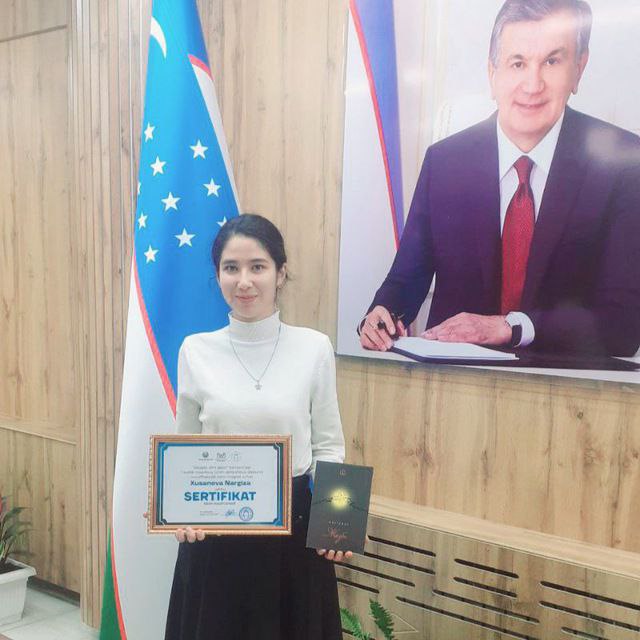
Foto cortesia di Khusanova Nargiza, Farkhod qizi
Khusanova Nargiza, Farkhod qizi, è nata il 30 novembre 2003 nel distretto di Khatirchi nella regione di Navoi. Si è diplomata alla scuola secondaria generale n. 78 nel distretto di Khatirchi, nella regione di Navoi. Attualmente è una studentessa del 3° livello dell’Istituto pedagogico statale di Bukhara. Studentessa dell’anno -23 Vincitrice OTM.
È autrice di una monografia sul tema della determinazione del ponte di potenza a corrente costante nel 2024 e attualmente lavora come coordinatrice del “Mushoira Club” presso l’istituto. Coordinatrice degli studenti dell’Istituto pedagogico statale di Bukhara dell’organizzazione primaria dell’Unione giovanile. Coordinatrice del dipartimento sportivo e sanitario della città di Girls’ Voice di Bukhara. Coordinatrice del Young Politician Girls Club dell’Istituto. E anche membro attivo dell’UzliDep a Bukhara
Oggi Bukhara è una città vivace e fiorente con una popolazione che supera i 275.000 residenti.
Tour di Bukhara
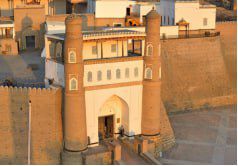
I tour di Bukhara invitano i viaggiatori in un viaggio nel tempo, rivelando una delle città medievali meglio conservate dell’Asia centrale. Con la sua straordinaria varietà di moschee, madrase e mausolei, questi tour offrono un’affascinante finestra sul passato della regione, dalla maestosa fortezza dell’Arca all’intricato design della Mir-i Arab Madrasah.
Prima di iniziare la tua avventura, arricchisci la tua esperienza familiarizzando con la profonda storia e gli incantevoli racconti di Bukhara.
Storia di Bukhara
Gli studiosi ritengono che Bukhara sia stata fondata intorno alla metà del primo millennio a.C. Durante gli scavi archeologici all’interno della città, sono stati scoperti manufatti come ceramiche, gioielli e resti di strutture del V secolo a.C.
La città di Bukhara fu menzionata per la prima volta tra il IV e il V secolo su monete che portano il suo nome. Nel VII secolo, lo studioso e traduttore cinese Xuanzang scrisse sulla città. Il nome “Bukhara” deriva dall’antica lingua uigura, che significa “casa di preghiera” o “tempio”. Tuttavia, varie fonti si riferiscono alla città con nomi diversi, tra cui Nyumi, Bukho, Buhe, Bukhala, Bumiskat, Fuho e Anxi.
Nel corso della sua storia, Bukhara è stata una città ambita da molti sovrani, passando di mano da un conquistatore all’altro. In epoca preislamica fungeva da centro culturale per l’Asia centrale.
Durante i secoli IX e X, Bukhara divenne la capitale dell’Impero Samanide. Figure famose, come Abu Ali Ibn Sina, Abu Abdullah Jafar Ibn Muhammad Rudaki, Omar Khayyam e altri, hanno vissuto e lavorato all’interno dei suoi confini.
Nei secoli successivi, lo splendore architettonico fiorì a Bukhara anche se cessò di essere la capitale. Numerose strutture medievali sono state conservate fino ad oggi. Sotto il regno di Tamerlano (Amir Timur), Bukhara iniziò ad emergere come centro religioso, guadagnandosi il soprannome di Bukhoroi Sharif, o Santo Bukhara.
Dopo la rivoluzione del 1917, molti edifici storici di Bukhara furono demoliti. Nel 1925, la città divenne parte della SSR uzbeka.
Nel 2020, l’Organizzazione del mondo islamico per l’istruzione, la scienza e la cultura ha designato Bukhara come capitale della cultura islamica.
Cibo a Buchara
Ci sono numerosi punti di ristoro a Bukhara, sia nel centro storico che nella periferia della città.
Cucina uzbeka
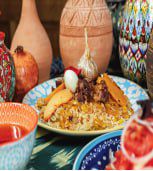
Il piatto uzbeko più popolare, il plov, può essere trovato in qualsiasi locale che serve cucina nazionale. Si dice che il plov più delizioso venga preparato al ristorante “Labi hovuz”. Altri piatti uzbeki possono essere gustati nei ristoranti Adras, The Plov, Temir’s, Shafran, Ismoil, Old Bukhara, Xo’ja Nasreddin café e Sham Chaikhana.
Khusanova Nargiza, Farkhod qizi, was born on November 30, 2003 in Khatirchi district of Navoi region. He graduated from general secondary school No. 78 in Khatirchi district, Navoi region. Currently, he is a student of the 3nd stage of the Bukhara State Pedagogical Institute. Student of the Year -23 OTM winner.
He is the author of a monograph on the topic of determining the constant current power bridge in 2024, and is currently working as a coordinator of the “Mushoira Club” at the institute. Bukhara State Pedagogical Institute student coordinator of the primary organization Youth Union. Girls’ Voice Bukhara city sports and health department coordinator. Institute’s Young Politician Girls Club coordinator. And also active member of UzliDep in Bukhara
Today, Bukhara is a vibrant, thriving city with a population exceeding 275,000 residents.
Bukhara Tours
Bukhara tours invite travelers on a journey through time, revealing one of the most well-preserved medieval cities in Central Asia. With its dazzling array of mosques, madrasahs, and mausoleums, these tours offer a mesmerizing window into the region’s past, from the awe-inspiring Ark fortress to the intricate design of the Mir-i Arab Madrasah.
Before beginning your adventure, enrich your experience by familiarizing yourself with the profound history and enchanting tales of Bukhara.
History of Bukhara
Scholars believe that Bukhara was established around the middle of the first millennium BC. During archaeological excavations within the city, artifacts such as pottery, jewelry, and remnants of 5th-century BC structures have been uncovered.
The city of Bukhara was first mentioned between the 4th and 5th centuries on coins bearing its name. In the 7th century, the Chinese scholar and translator Xuanzang wrote about the city. The name “Bukhara” is derived from the Old Uighur language, meaning “prayer house” or “temple.” However, various sources have referred to the city by different names, including Nyumi, Bukho, Buhe, Bukhala, Bumiskat, Fuho, and Anxi.
Throughout its history, Bukhara has been a coveted city for many rulers, changing hands from one conqueror to another. In pre-Islamic times, it served as a cultural hub for Central Asia.
During the 9th and 10th centuries, Bukhara became the capital of the Samanid Empire. Renowned figures, such as Abu Ali Ibn Sina, Abu Abdullah Jafar Ibn Muhammad Rudaki, Omar Khayyam, and others, lived and worked within its borders.
In the ensuing centuries, architectural brilliance flourished in Bukhara even as it ceased to be the capital. Numerous medieval structures have been preserved to this day. Under the reign of Tamerlane (Amir Timur), Bukhara began to emerge as a religious center, earning the moniker Bukhoroi Sharif, or Holy Bukhara.
Following the 1917 revolution, many historical edifices in Bukhara were demolished. By 1925, the city became part of the Uzbek SSR.
In 2020, the Organization of the Islamic World for Education, Science, and Culture designated Bukhara as the capital of Islamic culture.
Food in Bukhara
There are numerous dining options in Bukhara, both in the old center and on the outskirts of the city.
Uzbek Cuisine
The most popular Uzbek dish, plov, can be found at any establishment serving national cuisine. The most delicious plov is said to be prepared at the “Labi hovuz” restaurant. Other Uzbek dishes can be enjoyed at Adras, The Plov, Temir’s, Shafran, Ismoil, Old Bukhara restaurants, Xo’ja Nasreddin cafe, and Sham Chaikhana.
 Magiche Emozioni dell'Anima